Ukraine 2026. The weight of a country that was never peripheral
Grain, critical minerals, steel, energy and ten million people on the move: a reading of the war through the resources and numbers that explain why Ukraine was never a geopolitical periphery
by Piero Boccardo
When people talk about Ukraine, they still tend to do so in terms of borders, frontiers, a buffer zone between geopolitical blocs. Yet, before the full-scale war, Ukraine was already one of the most material hubs of the European continent. Not a margin, but a platform.
Its importance did not begin in 2022. It began much earlier, in the geography of its resources.
Ukraine is the largest country in Europe by arable land. It is one of the world’s biggest exporters of wheat, corn and barley. It is the world’s leading exporter of sunflower oil. This means a substantial part of the food security of Africa, the Middle East and Asia depends, directly or indirectly, on the stability of its farmland and its ports. When the Black Sea ports stop, it isn’t just a trade route that gets blocked: global food prices move, fragile economies are destabilized, inflation is ignited.
But Ukraine is not just Europe’s “breadbasket.” Beneath its soil lies a concentration of mineral resources that few other countries hold within the same geographic space. The country has some of the world’s largest manganese reserves, enormous iron ore deposits — around thirty billion tonnes — and is among Europe’s leaders in recoverable uranium reserves. It also plays a significant role in the titanium supply chain, a key material for aerospace and defense. Overall, it ranks among the world’s top countries by estimated value of natural resources.
These numbers tell a reality that is often underestimated: Ukraine is a first-rank industrial and energy player. Before the war it was among the world’s largest steel producers. It has one of Europe’s most extensive rail networks, an infrastructure that is essential for agricultural and mineral exports. It is among the European countries with the greatest installed nuclear capacity. Its gas transport system is a structural hub in energy flows toward the European Union.
Looking at the war only as a military confrontation means losing sight of this material dimension. Many of the areas most contested since 2022 coincide with industrial, mining and agricultural districts of high strategic intensity. The Donbas, historically the coal and steel heartland, is also one of the pillars of Ukraine’s heavy production. The southern regions are central to port access and agricultural exports. Nuclear plants are not merely symbolic targets, but vital energy nodes.
The war, then, is not fought only for control of territory in the abstract sense. It is fought for control of infrastructure, supply chains, and productive capacity. In an era of systemic competition and vulnerable global supply chains, Ukraine’s relevance has become even more evident.
From 2022 onward the country has been forced to transform into a war economy. Entire sectors have been converted, infrastructure destroyed or militarized, logistics reorganized under constant threat. Yet its critical mass — agricultural, mineral, industrial — remains a decisive factor for the European balance.
Understanding Ukraine through numbers does not mean reducing the war to a ledger of resources. It means understanding why its stability or instability directly affects global food security, European industrial autonomy, the energy transition, and the continent’s democratic resilience.
Ukraine was never peripheral. The war has simply made that impossible to ignore.
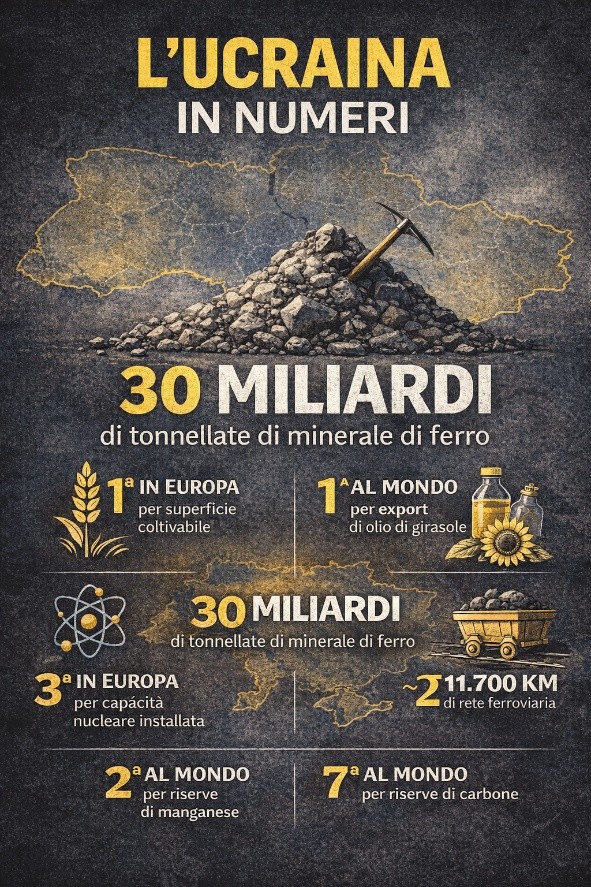
Figure 1 — Ukraine in numbers: first in Europe by arable land, world’s top exporter of sunflower oil, third in Europe by installed nuclear capacity, second in the world for manganese reserves. Source: original elaboration on public data.
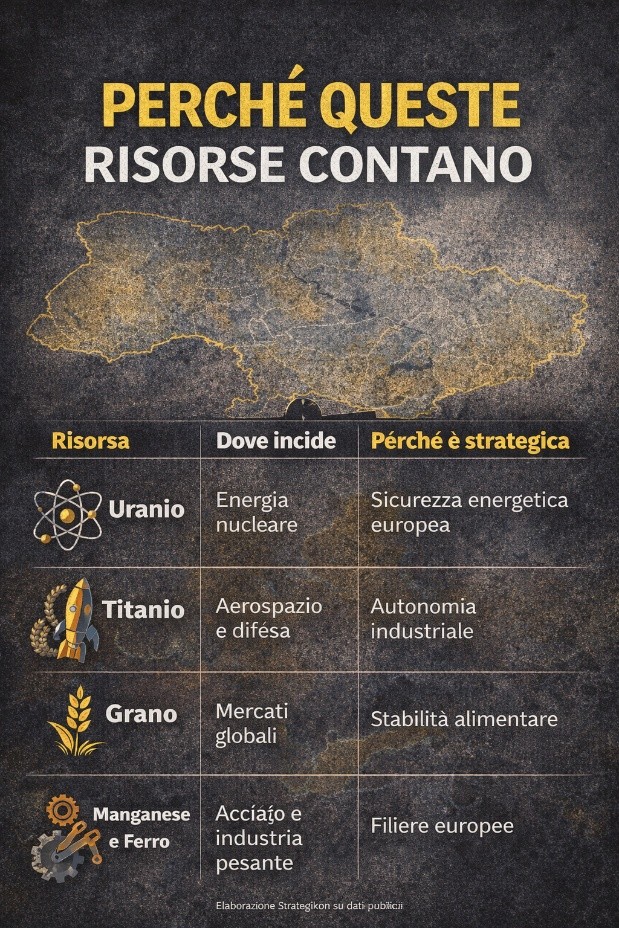
Figure 2 — Why these resources matter: uranium for European energy security, titanium for industrial autonomy in aerospace and defense, grain for global food stability, manganese and iron for European supply chains. Source: original elaboration on public data.
A displaced nation. The human cost of the long war
If the first dimension of the war is territorial, the second is demographic. And in Ukraine’s case this transformation is profound, structural, destined to leave traces for a generation.
Between 2022 and 2025 around ten million Ukrainians were forced to leave their homes. Some crossed national borders, others moved within the country, following the front line, seeking relatively safer cities, adapting to an unstable geography.
Today an estimated 5.7 million refugees live abroad, most of them hosted in European Union countries. On top of that, between 3.4 and 4.6 million people are internally displaced, living in a country that is still theirs, but in cities that were not. The sum tells a story of rupture: almost a quarter of the pre-war population has been forced to move.
It is not merely a humanitarian crisis. It is a demographic transformation.
A significant share of those who left the country are working-age women and children. Many men have stayed because of mobilization. This imbalance reshapes the structure of the workforce, affects birth rates, alters school and healthcare systems. Every month of war adds a further layer of complexity to any return.
Because return is not automatic.
Those who settled in Poland, Germany, the Czech Republic or Italy have found jobs, schools for their children, a new social network. The longer the conflict drags on, the greater the probability that part of this diaspora becomes permanent. Ukraine risks emerging from the war with a demographic deficit that will be difficult to recover in the short term. Within the country, displacement is continuous. Cities far from the front have absorbed hundreds of thousands of people, putting pressure on housing, services and infrastructure. The eastern and southern areas have instead undergone the opposite process: depopulation, destruction, interruption of economic activity.
The long war is not measured only in kilometers won or lost. It is measured in emptied neighborhoods, relocated schools, separated families.
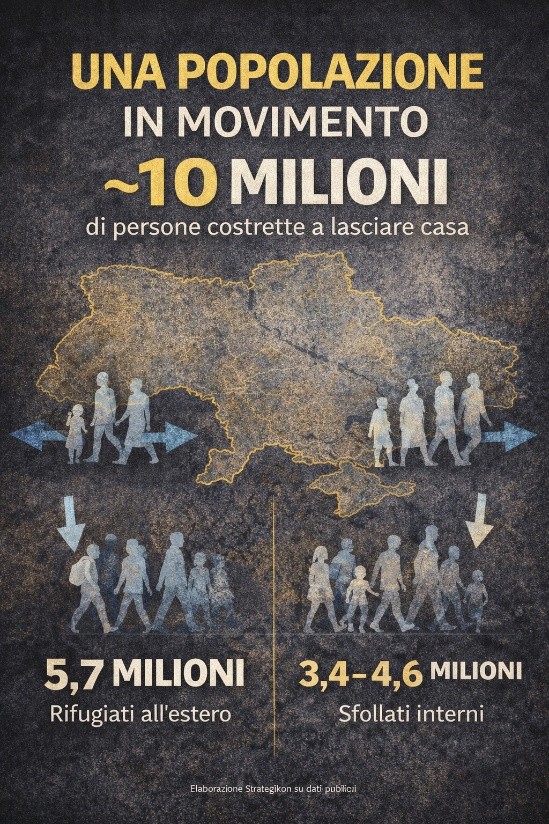
Figure 3 — A population on the move: around ten million people forced to leave home, 5.7 million refugees abroad, 3.4-4.6 million internally displaced. Source: original elaboration on public data.
Cities as a symbol of the war of attrition
Bakhmut has become the symbol of this logic. Between 2022 and 2024 the city was the theater of some of the most intense fighting of the conflict. The imagery shows a progressive erasure of urban space: buildings reduced to shells, collapsed infrastructure, entire blocks turned to rubble. What had been a mid-sized eastern city became a lunar landscape.
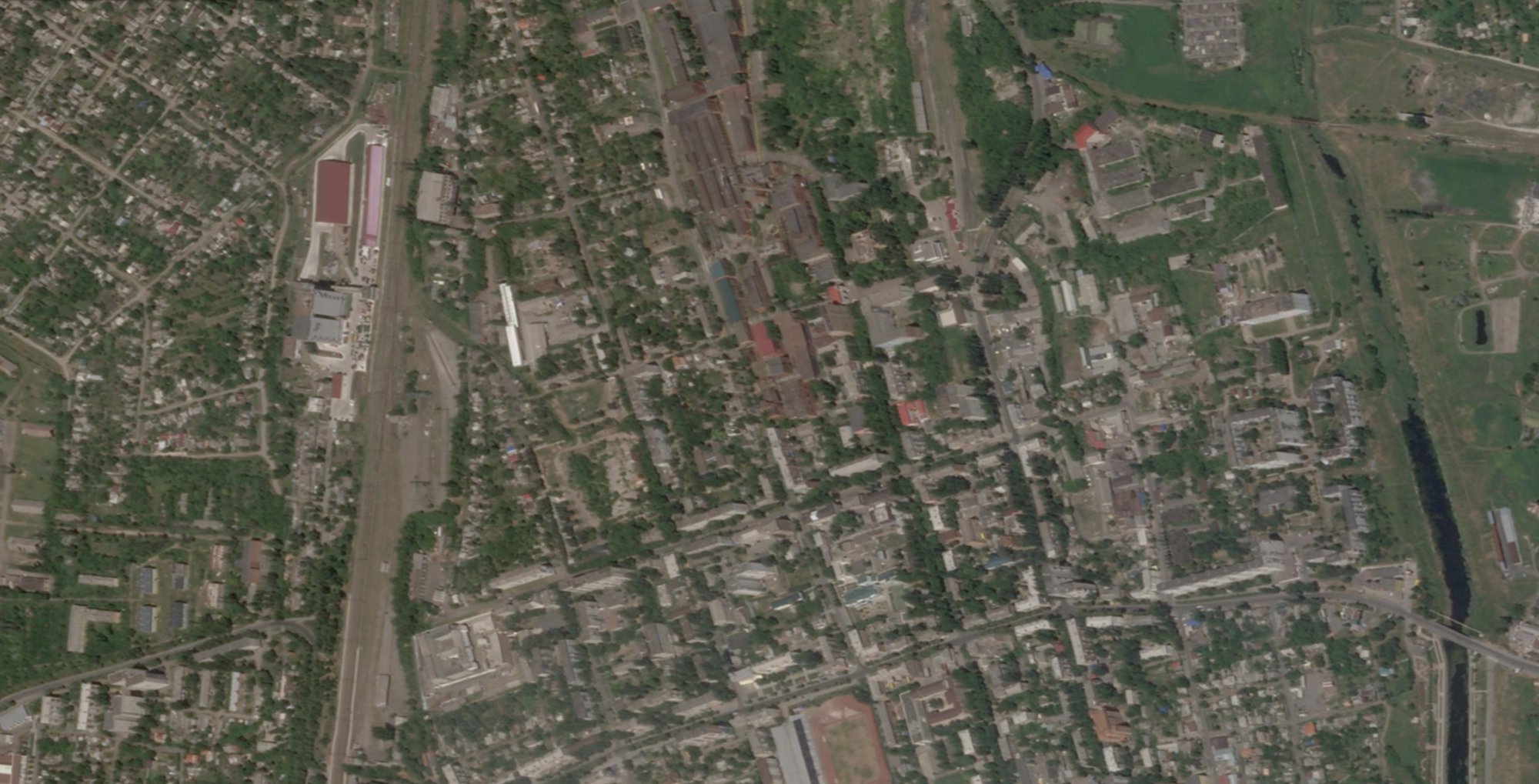
Figure 4 — Bakhmut, June 24, 2022: an intact urban fabric, orderly residential neighborhoods, the large industrial complex to the northwest still whole. Source: Planet Labs PBC.
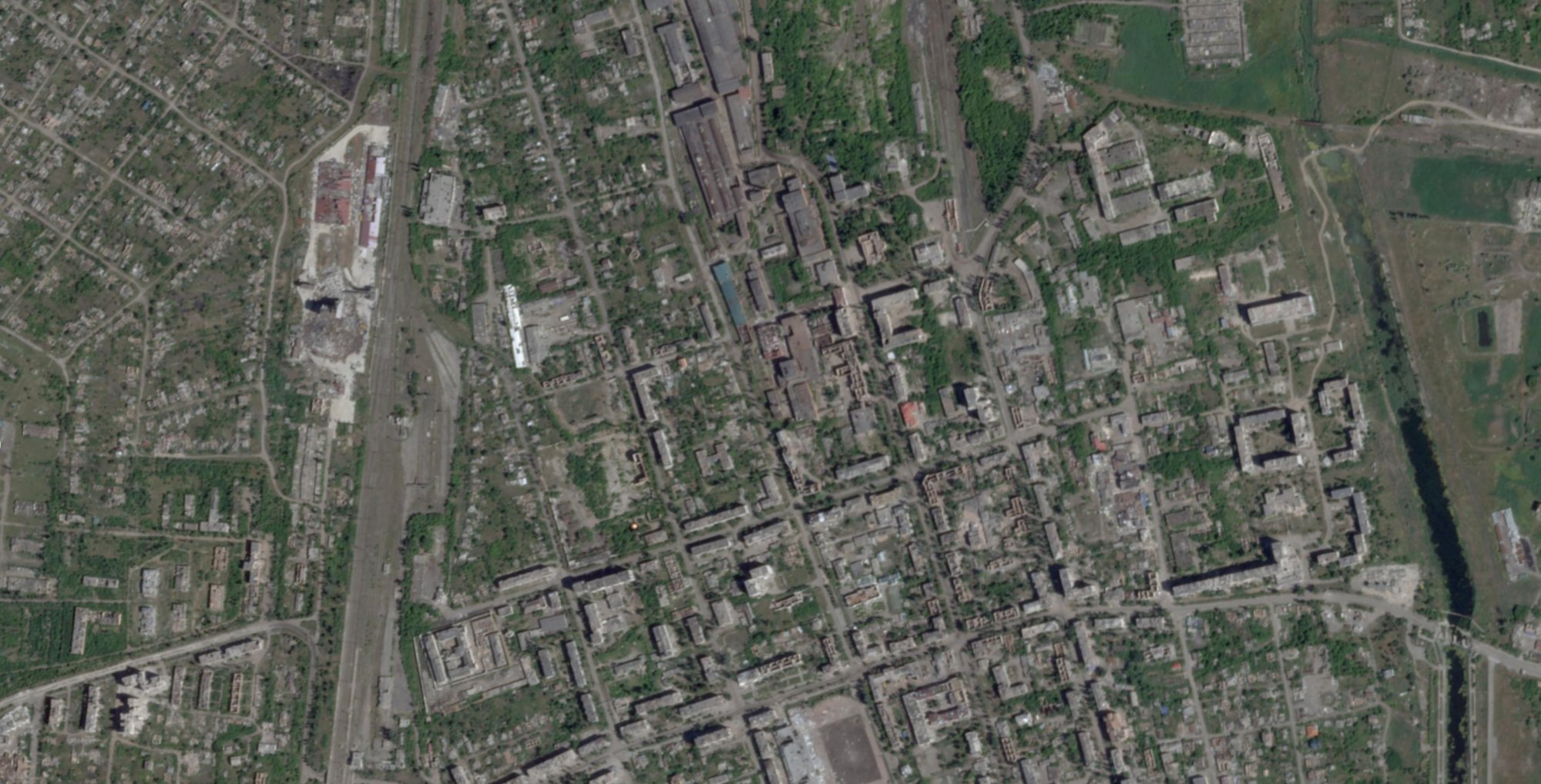
Figure 5 — Bakhmut, July 7, 2024: the same sector shows buildings reduced to shells, the industrial complex damaged, wide stretches of bare ground where residential blocks once stood. Source: Planet Labs PBC.
Chasiv Yar tells a similar trajectory. Between 2023 and 2025 the advancing front brought destruction and abandonment. Photographs taken two years apart show not only structural damage, but a mutation of the urban fabric: less life, fewer services, lower residential density.
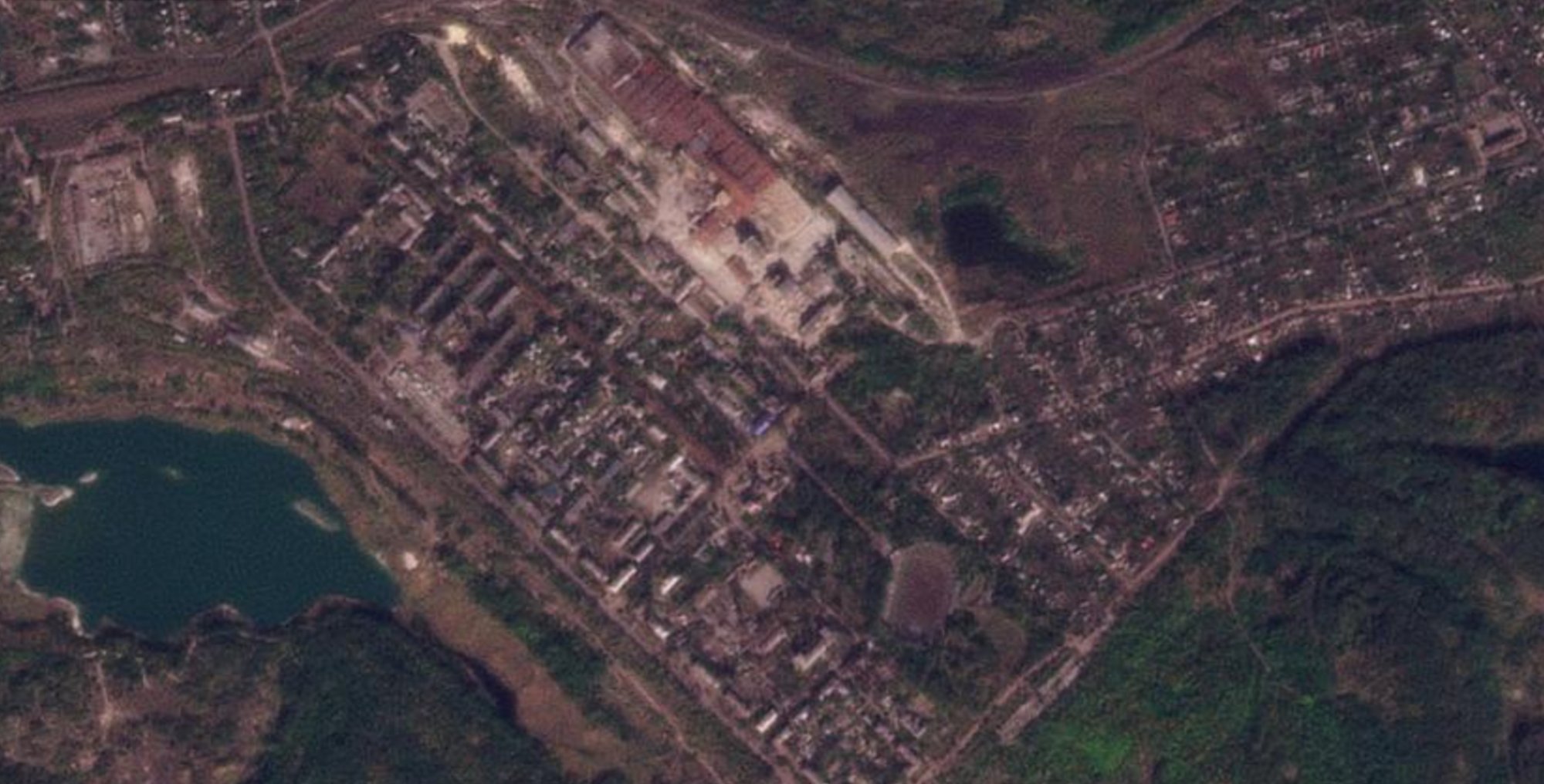
Figure 6 — Chasiv Yar, September 30, 2023: compact residential blocks, a large industrial complex with red roofs still intact, widespread green vegetation. Source: Planet Labs PBC.
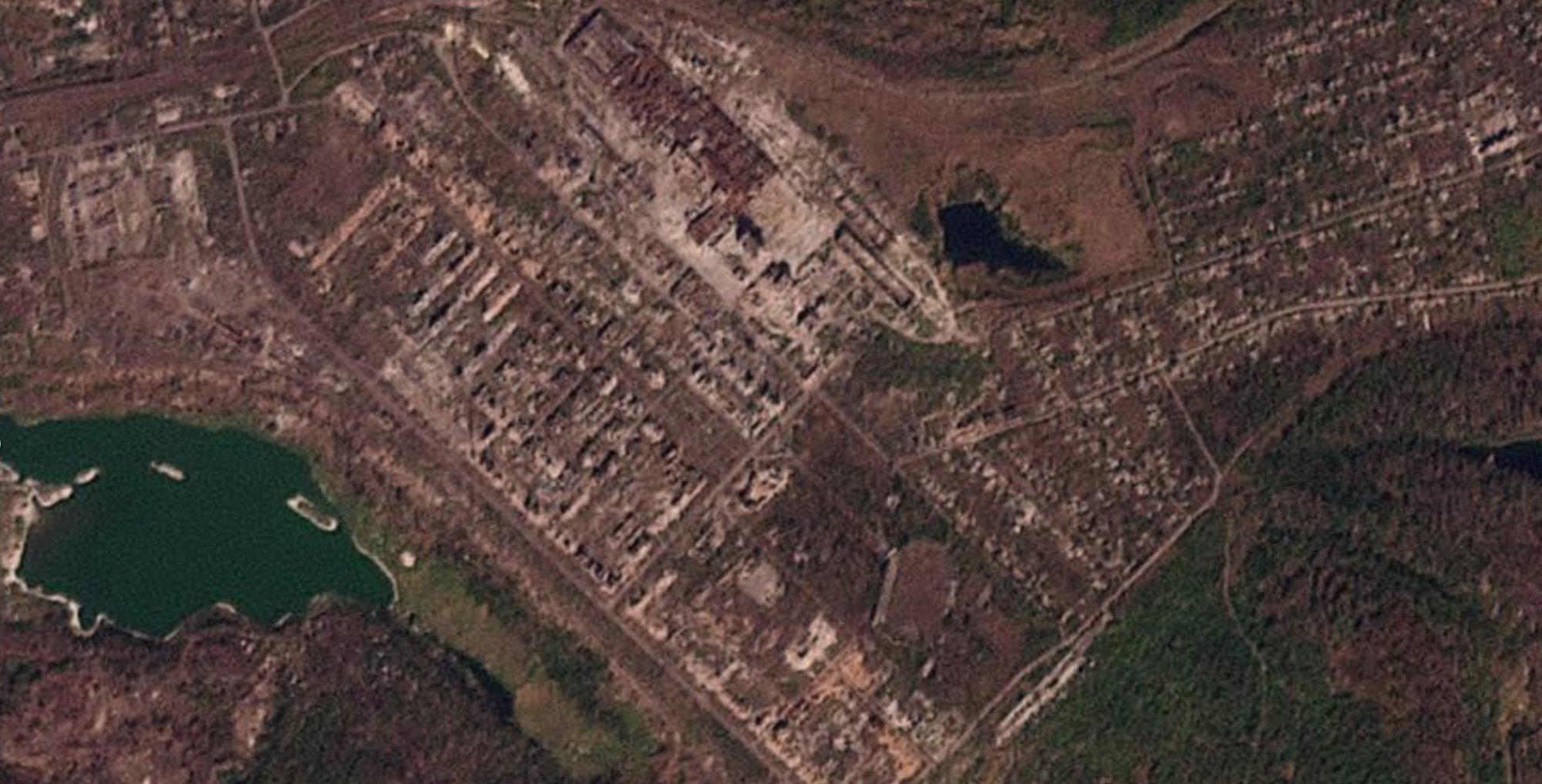
Figure 7 — Chasiv Yar, September 24, 2025: the same blocks appear reduced to rows of skeletal buildings, the surrounding ground scorched, the industrial complex heavily damaged. Source: Planet Labs PBC.
In these cities, time is measured in cycles of shelling and reconstruction that never happens.
Urban destruction has a multiplier effect on demographics. When a city loses homes, hospitals, schools, it also loses the ability to retain or draw back its population. Reconstruction is not just a matter of buildings: it is a precondition for return.
Europe as a space of reception and transformation
The presence of millions of Ukrainian refugees has also had an impact on European societies. In many countries, integration into the labor market happened relatively quickly, especially in sectors with the greatest labor shortages. But this relative success raises a longer-term question: how many of these people will return to Ukraine once conditions allow?
The answer will depend on three factors: security, economic opportunity, political outlook. If the war turns into a frozen conflict with permanent risk, the return will be partial. If instead a credible phase of stabilization and reconstruction opens up, the diaspora could become a lever for development, bringing back human capital, skills and European networks.
The human dimension of the war, then, is not only its most painful cost. It is also one of its strategic factors. Population is a resource. Its dispersal or recomposition will influence Ukraine’s ability to rebuild its economy, institutions, and defense. After four years of full-scale conflict, Ukraine is not only contested territory. It is a society redistributed across European space. And its demographic trajectory will be as decisive as its military one.
The economy under attack: energy, grain and industry in the systemic war
Every war is also an economic war. In Ukraine’s case, this dimension is not secondary: it is central. The conflict has turned the country into a laboratory of industrial warfare, where infrastructure, supply chains and production capacity become targets just as much as the front lines.
The first test was grain. When the Black Sea ports were blocked or threatened in 2022, the effect was not limited to the balance sheets of Ukrainian agricultural companies. Global markets reacted immediately. Food commodity prices rose, hitting the most fragile economies of the Mediterranean, the Middle East and sub-Saharan Africa especially hard. Before the war, Ukraine exported tens of millions of tonnes of grain every year. Interrupting that flow meant striking one of the arteries of global food security. The partial reopening of grain corridors and the reorganization of overland routes eased the impact, but did not eliminate it. Logistics became more expensive, slower, more vulnerable. Every attack on a port or a rail line has an effect that spills beyond the national border.
The war, in this sense, behaves like a multiplier of systemic risk.
Energy as a battlefield
Ukraine is also an energy hub. Before the full-scale invasion, its gas transport system was one of the main corridors toward Europe. The country also has significant installed nuclear capacity, among the most substantial on the continent.
Nuclear plants are not just civilian infrastructure: they are strategic nodes. Their control or vulnerability affects the stability of the entire national electricity system. Attacks on energy grids, which have become recurrent especially in the winter months, have shown how contemporary warfare aims to strike civilian resilience as much as military capacity. Shutting down a plant, damaging a substation, interrupting power distribution means striking industrial production, healthcare services, daily life. The goal is not only to reduce military capacity, but to wear down social cohesion.
In parallel, Europe has had to accelerate its energy diversification process. The war has forced the Union to reconsider dependencies, routes and suppliers. In this sense, Ukraine has become an integral part of the redefinition of European energy security.
Heavy industry and military production
Before 2022 Ukraine was among the world’s largest steel producers. The eastern regions hosted major steel plants and industrial complexes. The war has directly hit this production base, destroying or disabling several facilities.
But industry has not disappeared: it has transformed. Ukraine’s economy has undertaken a forced conversion toward military production and weapons-system maintenance. A war of attrition requires constant capacity for repair, adaptation, innovation. Drones, defense systems, munitions: the industrial dimension of the conflict has become evident. This process fits into a broader picture. Europe itself has rediscovered the need to strengthen its own defense industrial base. The war in Ukraine has exposed production limits, delays in ammunition supply, technological dependencies. The eastern front has also become a test of the West’s capacity to sustain a prolonged war.
A war for infrastructure
Looking at the map of energy bombardments, hit ports, and severed rail lines, a common thread emerges: the centrality of infrastructure. It is not just about conquering territory, but about rendering the opponent’s productive capacity unusable.
In this framework, Ukraine represents much more than a theater of operations. It is a node in the competition between models of power. On one side, a system that aims to integrate economic, energy and democratic security. On the other, a strategy that uses military coercion to alter structural balances.
The systemic war fought on Ukrainian territory is about control of networks: energy networks, logistics networks, industrial networks. And this is where the economic dimension intertwines with the strategic one. Because Ukraine’s ability to keep its infrastructure running, to export, to produce energy and steel, is not just a matter of GDP. It is a matter of national survival and European stability. The front line, after all, does not run only between trenches and minefields. It runs along high-voltage cables, inside grain silos, along the rail tracks that connect mines and ports.
And that is where a decisive part of the long war is being played out.
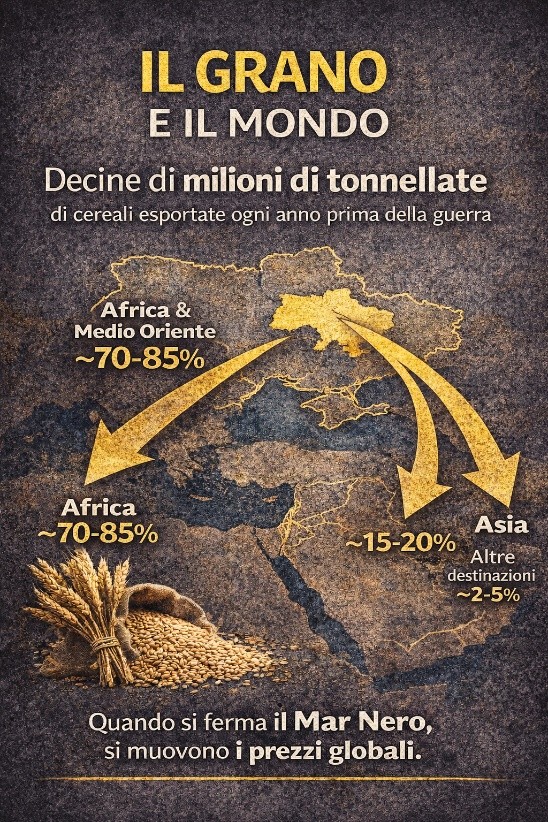
Figure 8 — Grain and the world: tens of millions of tonnes of cereals exported every year before the war, 70-85% to Africa and the Middle East. When the Black Sea stops, global prices move. Source: original elaboration on public data.
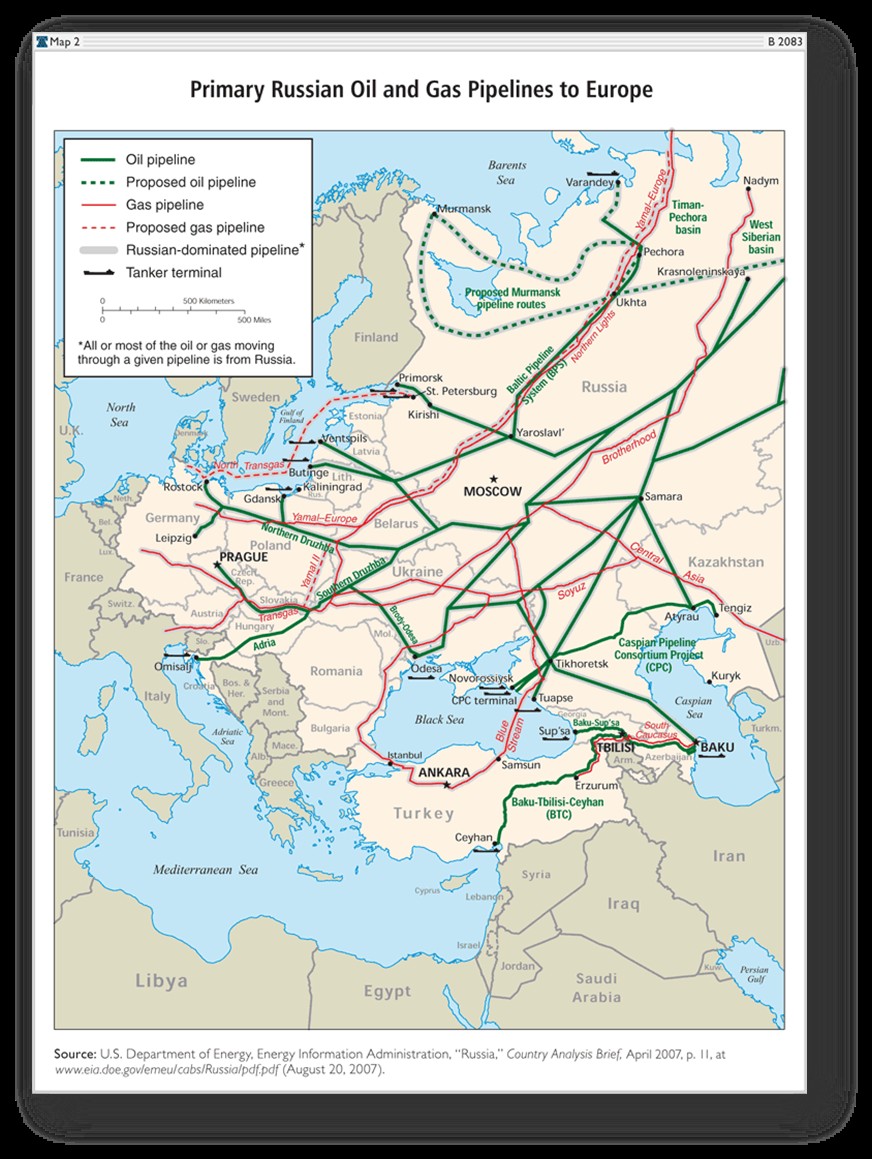
Figure 9 — A historical (2007) map of the network of Russian oil and gas pipelines to Europe, including routes that crossed Ukrainian territory. It is a snapshot of the pre-war layout, included here for illustrative purposes only: it does not reflect the changes that have occurred since 2022, including the sabotage of the Nord Stream pipelines, the halt of gas transit through Ukraine, and the sharp reduction of flows to the European Union. Source: U.S. Department of Energy, Energy Information Administration (2007).
The long war and Europe’s future
After four years of full-scale war, one thing is clear: the conflict in Ukraine is not an isolated event, but a structural transformation of the European order. It is not just a border war. It is a systemic war.
The front line has moved, stabilized, oscillated. But the most significant fact is not the territorial variation. It is the nature of the conflict. Ukraine has become the laboratory of the long war, a war in which attrition, industrial production, resilience and international support matter as much — if not more — than spectacular offensives.
Contemporary warfare is a combination of dimensions. Conventional, because tanks and artillery remain central. Technological, because drones, satellite intelligence and electronic warfare reshape the operational field. Economic, because infrastructure and supply chains are permanent targets. Informational, because public perception influences political will.
In this web of dimensions, Ukraine has become an advanced frontier of Europe.
Attrition and resilience
The conflict has shown how decisive the ability to endure over time is. Not only for Kyiv, but also for its allies. The war of attrition consumes munitions, financial resources, political consensus. It forces democracies to test their own strategic patience.
Every winter, every new offensive, every aid package voted through or blocked becomes part of a broader dynamic. The stability of Western support is as significant a factor as military capacity on the ground. In this sense, Ukraine is not fighting only for its own territory. It is fighting for the credibility of Europe’s security architecture. If a full-scale aggression produces a forced change of borders, the message does not concern only Eastern Europe. It concerns the whole continent.
Beyond the battlefield: the hybrid dimension
The war in Ukraine has also made evident the hybrid nature of contemporary threats. Cyberattacks, sabotage, disinformation campaigns, economic pressure: the conflict is not confined to the physical front. Europe has had to strengthen the protection of its critical infrastructure, increase vigilance over energy grids, ports, telecommunications. Security has become an ecosystem involving governments, businesses, universities, civil society.
The line separating the Ukrainian theater from European space is growing thinner.
Three possible trajectories
Looking toward 2026 and beyond, three plausible trajectories emerge.
The first is a frozen war, with a stabilized front but permanent tension. In this scenario the conflict does not end, but settles, keeping strategic uncertainty high.
The second is a regional escalation, with a direct or indirect widening of the confrontation. This would mean a leap in risk for the entire European system.
The third is prolonged attrition, in which neither side achieves a decisive victory but the conflict continues to consume resources and stability.
None of these scenarios is neutral for Europe. All of them imply growing investment in defense, energy, and industrial resilience.
The European meaning of the war
In the end, the question does not concern only Ukraine. It concerns Europe.
The war has forced the continent to reconsider concepts that seemed outdated: deterrence, defense industry, energy security, strategic autonomy. It has shown that peace is not a permanent state but a political, economic and military construction. Ukraine, with its grain, its mines, its infrastructure and its dispersed population, has become the point where these dimensions meet.
It is no longer just a geographic frontier. It is a historical threshold. How the conflict evolves will determine not only Kyiv’s future, but the very shape of Europe in the coming decades. A Europe more aware of its own vulnerability, or a Europe capable of turning that vulnerability into resilience. The long war is not only a test for Ukraine. It is a test for the West. And its outcome will not be measured only in kilometers of territory, but in the capacity to defend an open, democratic and shared model of security.
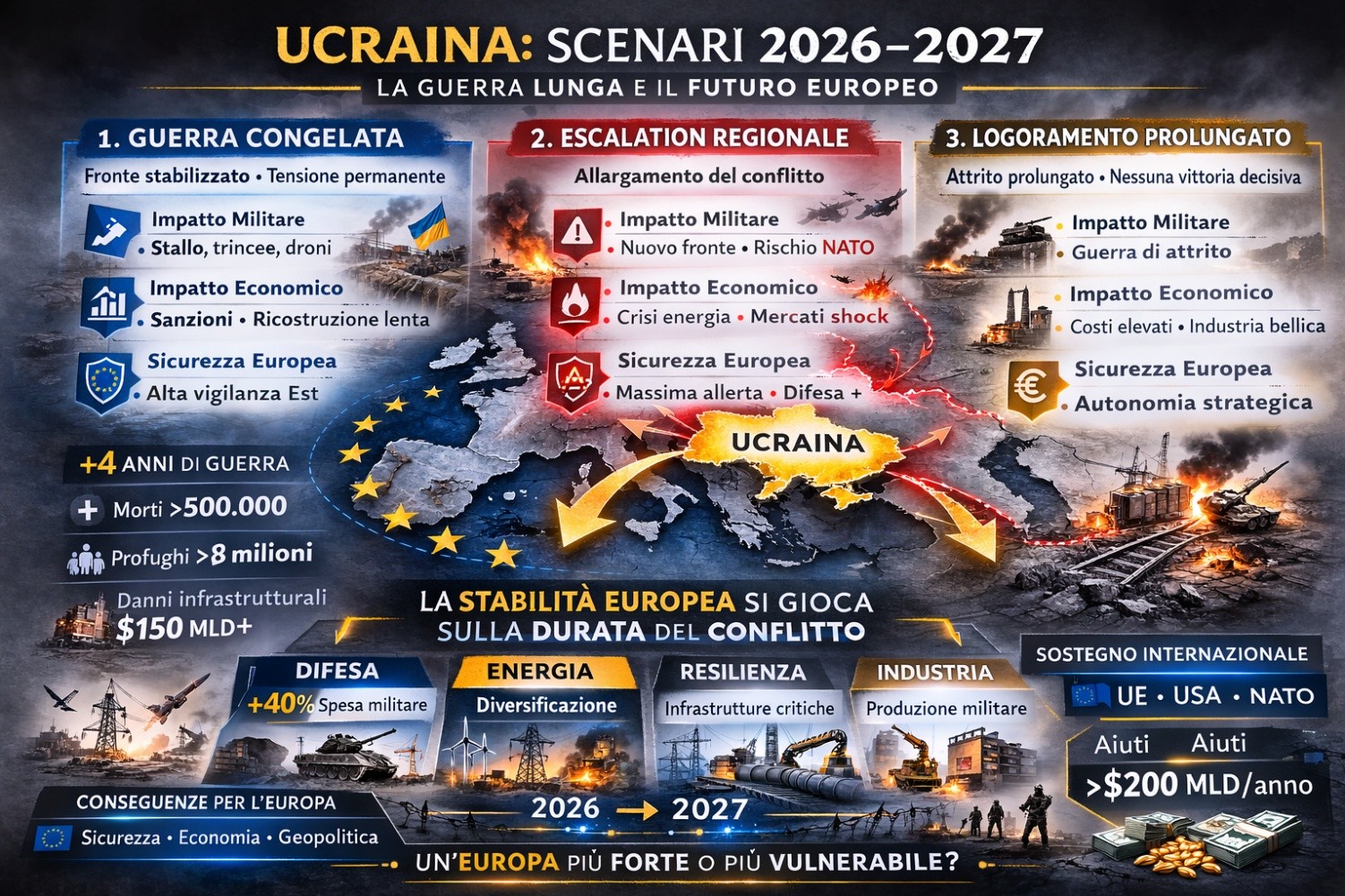
Figure 10 — Three scenarios for 2026-2027: frozen war, regional escalation, prolonged attrition. In all three cases, European stability hinges on how long the conflict lasts: more than four years of war, over 500,000 deaths, more than 8 million refugees, over $150 billion in infrastructure damage. Source: original elaboration on public data.