The Mecca Pact, in numbers
Pakistan, Saudi Arabia and Turkey have signed a mutual defense agreement whose contours are deliberately ambiguous. The maps of their bases and the data on their armies tell the story of three countries with very different priorities, forces and alliance networks
by Piero Boccardo, Nicolò Russo Perez
Talks had been going on for nearly three years, but it was the war between Israel, the United States and Iran, with its regional shockwave, that accelerated the conclusion. The Mecca Joint Defense Agreement, signed by Pakistan, Saudi Arabia and Turkey, was born at a moment when the limits of the security architecture the Gulf Arab states have relied on until now have become evident to everyone, as Emily Tasinato reconstructed well in a commentary for the CSF Foundation on August 25, 2026, from which this piece takes its starting point. The text of the agreement remains largely non-public and, as Tasinato notes, its strength lies precisely in its ambiguity: no defined operational parameter, no automatic threshold, everything left to “consultations” to be held case by case. Calling it a “Muslim NATO,” as has been done in several commentaries, is misleading: it is above all a diplomatic signal.
But ambiguity on paper does not mean the three signatories sit at the table on equal footing. Placed side by side, the numbers of their armies and the geography of their bases describe three countries that are profoundly different in force structure, strategic priorities and degree of autonomy from outside allies, including the one major ally none of the three mentions explicitly in the agreement: the United States.
Three armies, three profiles
Pakistan has, by a wide margin, the largest army among the three signatories (660,000 active personnel and another 550,000 reservists, according to the most recent estimates), but the smallest defense budget: just over 9 billion dollars, less than a sixth of Saudi Arabia’s. Turkey has 481,000 active personnel, 380,000 reservists and a budget of around 51 billion dollars. Saudi Arabia has the lowest number of active personnel, 247,000, and a striking figure: officially zero reserves. It is a relatively small army but by far the best funded, with over 64 billion dollars in defense spending, nearly seven times Pakistan’s.
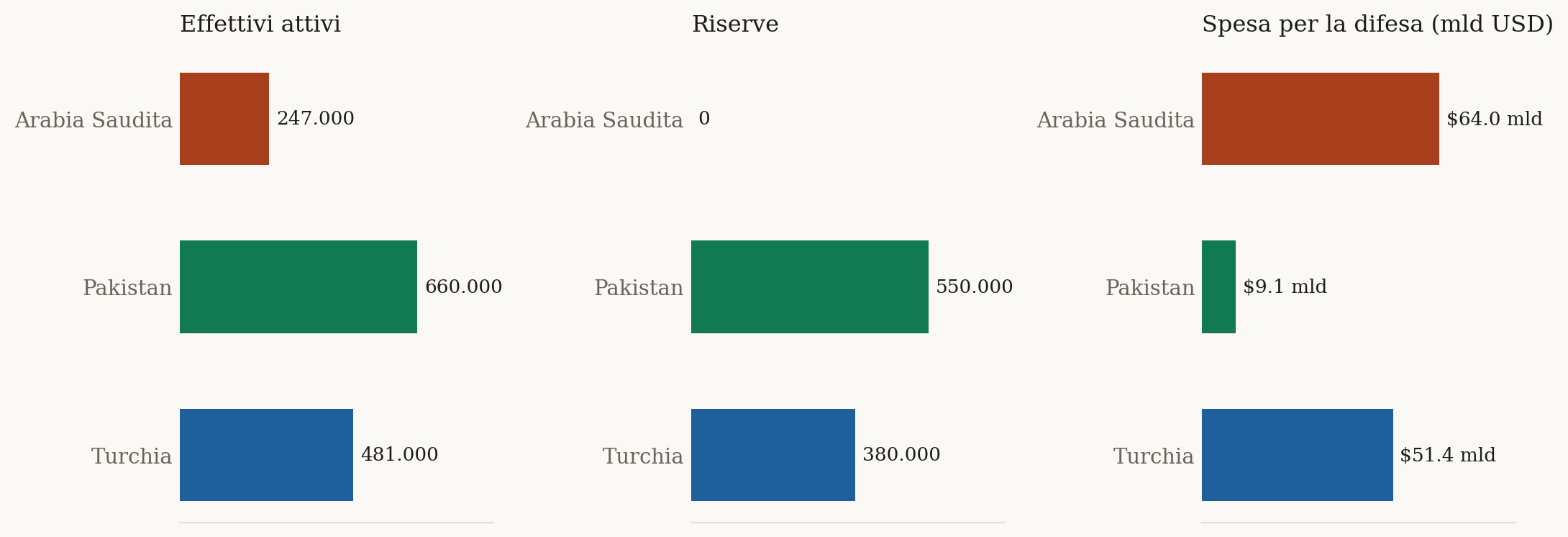
Figure 1 — Active personnel, reservists and defense spending of Saudi Arabia, Pakistan and Turkey. Source: GlobalFirepower (2026 data); Wikipedia/Pakistan Armed Forces for the detail of Pakistani reserves.
These are force profiles built for different tasks. Pakistan maintains a mass army oriented mainly toward the border with India, which, as Tasinato also recalls, remains Islamabad’s primary adversary, far more than the Middle Eastern context of the Mecca pact. Saudi Arabia has invested in equipment and technology more than in numbers, with spending per active soldier that is over twenty times Pakistan’s. Turkey sits in an intermediate position, but is the only one of the three signatories with a genuine defense industry capable of sustaining, alongside its personnel numbers, a network of overseas bases with no equivalent in the region.
Where the bases are, at home
The geographic distribution of the installations reflects the same imbalances. In Saudi Arabia the main bases (the two naval bases of Jeddah and Jubail, the air bases of Tabuk, Dhahran and Khamis Mushait, the strategic missile complex around Riyadh) are almost all oriented outward: toward the Red Sea, the Gulf, the Yemeni border. In Pakistan the installations are concentrated in the Rawalpindi-Islamabad-Karachi triangle, the administrative and industrial heart of Pakistani defense, with a single westward projection at Gwadar, the strategic port on the Arabian Sea developed with Chinese capital. In Turkey the bases cover the entire territory from west to east, from Izmir to Diyarbakır: the most politically sensitive node of the three countries is Incirlik, which still hosts US nuclear weapons under NATO nuclear sharing.
There is a detail the map makes visible better than any communiqué: both Saudi Arabia (Prince Sultan Air Base) and Turkey (Incirlik) still host bases that are, in effect, American or NATO ones. This is what makes it misleading to read the Mecca pact as an attempt to “replace” the American security umbrella: as Tasinato notes, the agreement is designed to remain compatible with the burden-sharing logic within the security ecosystem tied to Washington, not to exit it.
Where the bases are, abroad
It is in overseas projection that the differences among the three signatories become sharpest. Saudi Arabia has no permanent military bases outside its own borders. Pakistan mainly has personnel deployed with allied countries: about 2,600 troops in Saudi Arabia and 650 in Qatar, according to the most recent estimates. Turkey, on its own, runs a network stretching from the Balkans to the Horn of Africa: Northern Cyprus (35,000-40,000 troops, the Turkish Cypriot Peace Force), Qatar (a joint base, thousands of troops), northern Iraq, northern Syria (dozens of outposts), western Libya (air support for the Tripoli government), Kosovo (as part of the NATO KFOR mission), Albania (a naval base) and Mogadishu, where Camp TURKSOM is, by permanent personnel numbers, the largest Turkish base abroad. (See the star markers on the map above, “abroad” layer.)
It is no coincidence that the CSF commentary cites the Horn of Africa, particularly Somalia and Sudan, as one of the areas where cooperation between Ankara, Islamabad and Riyadh had already taken shape even before the war in Iran: it is exactly there, in Mogadishu, that Turkey already has the most solid infrastructure of the three signatory countries, training included, to project power far from its own borders.
An agreement between unequal weights
Taken together, these numbers explain why the Mecca pact is, as Tasinato writes, above all diplomatic weight rather than a collective defense machine. A binding mutual defense agreement would need armies built on a shared logic; here it brings together the country with the most people under arms and the smallest budget (Pakistan), the country with the highest spending and zero reserves (Saudi Arabia), and the only one of the three with an overseas base network of regional scale (Turkey). Each has its own primary threat: for Riyadh it is the Houthis and Iran, for Ankara it is Israel, for Islamabad it remains India. It is precisely this heterogeneity, more than a design flaw, that explains why the agreement deliberately leaves undefined what would happen if one of the three were seriously attacked: for now, its usefulness lies in existing as an option, not in being put to the test.
Methodological note
The 191 “domestic” installations were collected by querying OpenStreetMap through the Overpass API, for all elements tagged military=* or landuse=military within the administrative borders of Saudi Arabia, Pakistan and Turkey, cross-checked against a Wikidata SPARQL query for air bases, naval bases and known military installations in the same three countries. When an installation appeared in both sources, with the same Wikidata identifier, confidence was raised from medium to high. The raw result, over a thousand points, was then classified and reduced to the four categories shown on the map (air bases, naval bases, depots, training areas), discarding entries that were too generic or not verifiable with sufficient certainty.
The 10 “overseas” positions follow a different logic: they are hand-geocoded from the locations cited in the open sources used for the text, in particular the Wikipedia entries “Turkish Armed Forces” and “Pakistan Armed Forces,” and are not verified against satellite imagery. They should be read as indicative of the area, not as the exact position of a gate or a runway.
A version of this contribution was published as Commento N. 050 NS/2026 by the CSF Foundation (August 31, 2026), by Piero Boccardo and Nicolò Russo Perez. The contribution integrates the commentary “The Mecca Joint Defense Agreement: A New Layer of Regional Security Cooperation?” by Emily Tasinato, Visiting Fellow at the CSF Foundation (Commentary N. 048 NS/2026, August 25, 2026), with original data and cartography. Data on personnel and defense spending: GlobalFirepower (2026). Domestic bases: OpenStreetMap contributors (military=/landuse=military tags) and Wikidata, August 2026. Bases and contingents abroad: Wikipedia, “Turkish Armed Forces” and “Pakistan Armed Forces” entries (accessed August 2026), indicative positions.*