The geography of violence: mafia murders in Palermo and Sicily (1970-1992)
From the mattanza in the streets of Palermo to the war with the Stidda and the 1992 bombings: where and how people were killed, and what the data do not tell. Part two of two
by Piero Boccardo
In the first part we followed the Corleonesi as they conquered the mandamenti. In this second part we look at the violence that accompanied that conquest, first at street level in Palermo, then at the scale of the island. The Maxi Trial indictment devotes three volumes to the “so-called mafia war” and two to the murders of state officials and other crimes: for each event it reports date, time, place, victims, weapons and defendants. From those pages we extracted 86 events that took place in the city of Palermo between 1978 and 1984, including murders, attempted murders, massacres and disappearances, with a total of 101 victims, and placed them on the map declaring the accuracy of each position. For the rest of Sicily and for the years after the Maxi Trial we added the vittimemafia.it archive, reaching 316 events in 72 municipalities between 1970 and 1992.
Two findings emerge. In Palermo violence is not randomly distributed: more than two thirds of the located events fall in just two mandamenti, Ciaculli and Porta Nuova, while servants of the State are killed in another Palermo, the middle-class districts north of the centre. At the regional scale, documented violence shifts its centre of gravity over time: between 1981 and 1983, 60% of events take place in the city of Palermo; between 1990 and 1992 the share falls to 15%, while the provinces of Agrigento, Caltanissetta and Enna reach 32%.
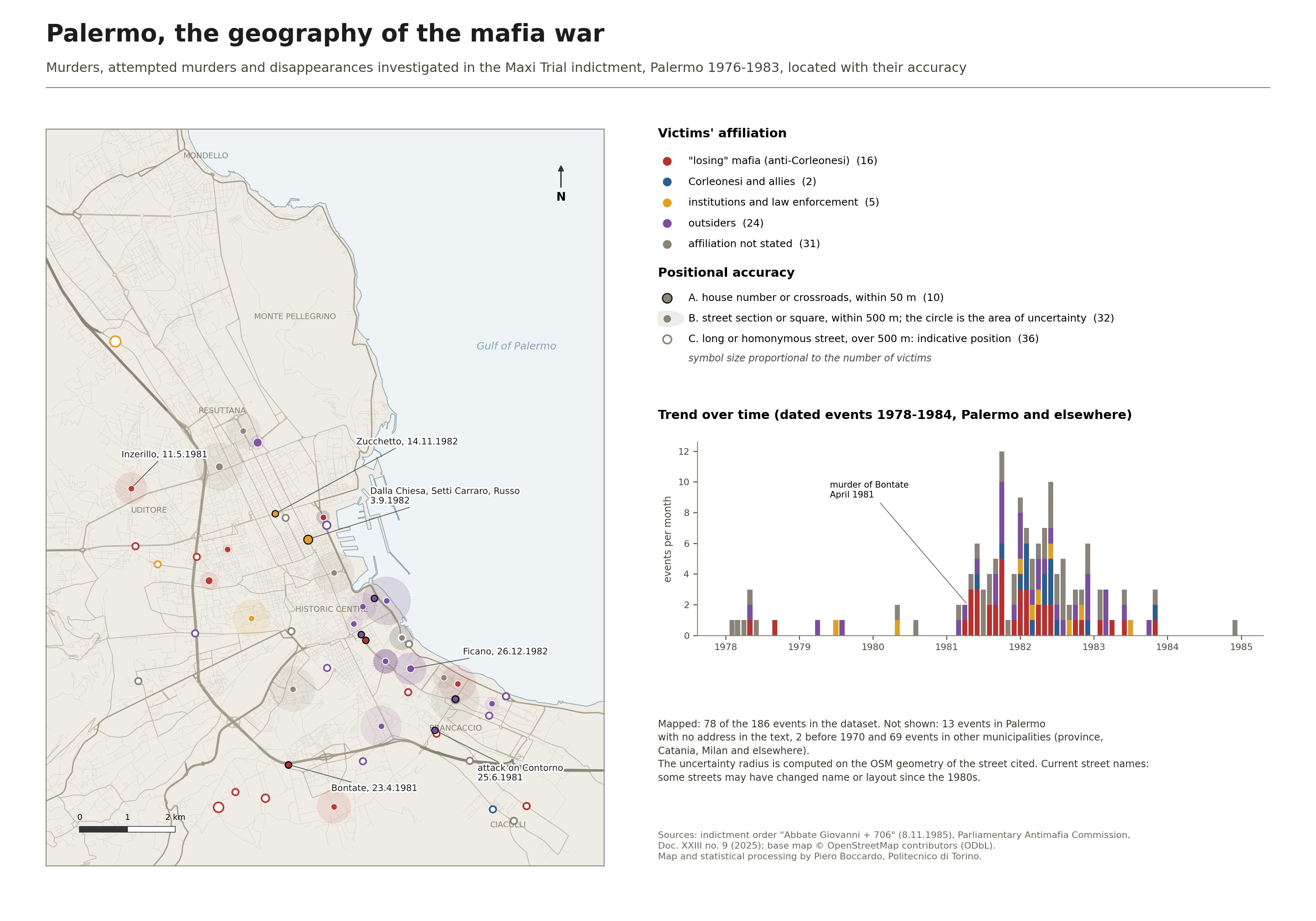 Figure 1. Murders, attempted murders and disappearances in Palermo investigated in the Maxi Trial indictment. Colour indicates the victims’ affiliation, the symbol the positional accuracy, the dashed circle the area of uncertainty. On the right, the monthly trend of events. Source: indictment order “Abbate Giovanni + 706”; OpenStreetMap base map; author’s processing.
Palermo, a chronology in three phases
The first phase runs from 1978 to 1980. The events investigated are few, ten in three years, but they already point the way. On 30 May 1978 Giuseppe Di Cristina, boss of Riesi and an opponent of the Corleonesi, is killed in via Leonardo da Vinci. On 21 July 1979 Boris Giuliano, head of the Flying Squad who was investigating the heroin trade, is killed at the Bar Lux in via Francesco Paolo Di Blasi. In May 1980 Carabinieri captain Emanuele Basile falls in Monreale. These are the years in which the Corleonesi strike investigators and let suspicion fall on their internal adversaries.
The second phase is the war proper, which begins on 23 April 1981 with the murder of Stefano Bontate and intensifies throughout 1982. The events investigated in Palermo rise to 28 in 1981 and 38 in 1982. The densest month is October 1981, with nine events in a few weeks. In this phase the internal war and the war against the State proceed together: on 11 August 1982 the forensic pathologist Paolo Giaccone, who had refused to alter an expert report, is killed at the Policlinico hospital; on 3 September, shortly after 9 pm, in via Isidoro Carini, prefect Carlo Alberto Dalla Chiesa, his wife Emanuela Setti Carraro and police officer Domenico Russo are killed; on 14 November in via Notarbartolo it is the turn of Flying Squad officer Calogero Zucchetto. On 26 December 1982, in via Salvatore Cappello, two members of the Ficano family are killed in a reprisal that closes the year.
The third phase, from 1983, is one of normalisation. The events investigated fall to nine in 1983 and one in 1984, but not because the violence ends: the winning faction now controls the commission and executions become more selective. On 29 July 1983 a car bomb outside his home kills chief investigating judge Rocco Chinnici, the man who had created the antimafia pool, together with two Carabinieri of his escort and the building’s caretaker.
Palermo, where people were killed
Figure 2 assigns the events located at least at street level to the mandamenti as they were in 1981. The Ciaculli mandamento, which then also included Brancaccio, corso dei Mille and the coastal strip up to Settecannoli, accounts for 33 of 78 events, Porta Nuova for 21. Together they make up 69%. The eastern part of the city was the territory of Filippo Marchese’s corso dei Mille group, the armed wing of the Corleonesi in the war: the indictment describes an abandoned house in piazza Sant’Erasmo, on the sea front, as the usual place where victims were taken and strangled before their bodies were made to disappear. Many of the victims in this area are classified by the indictment as outsiders to the organisation or of unspecified affiliation: petty criminals, shopkeepers, people killed for a slight, a sign that the war also served to re-establish control over the territory.
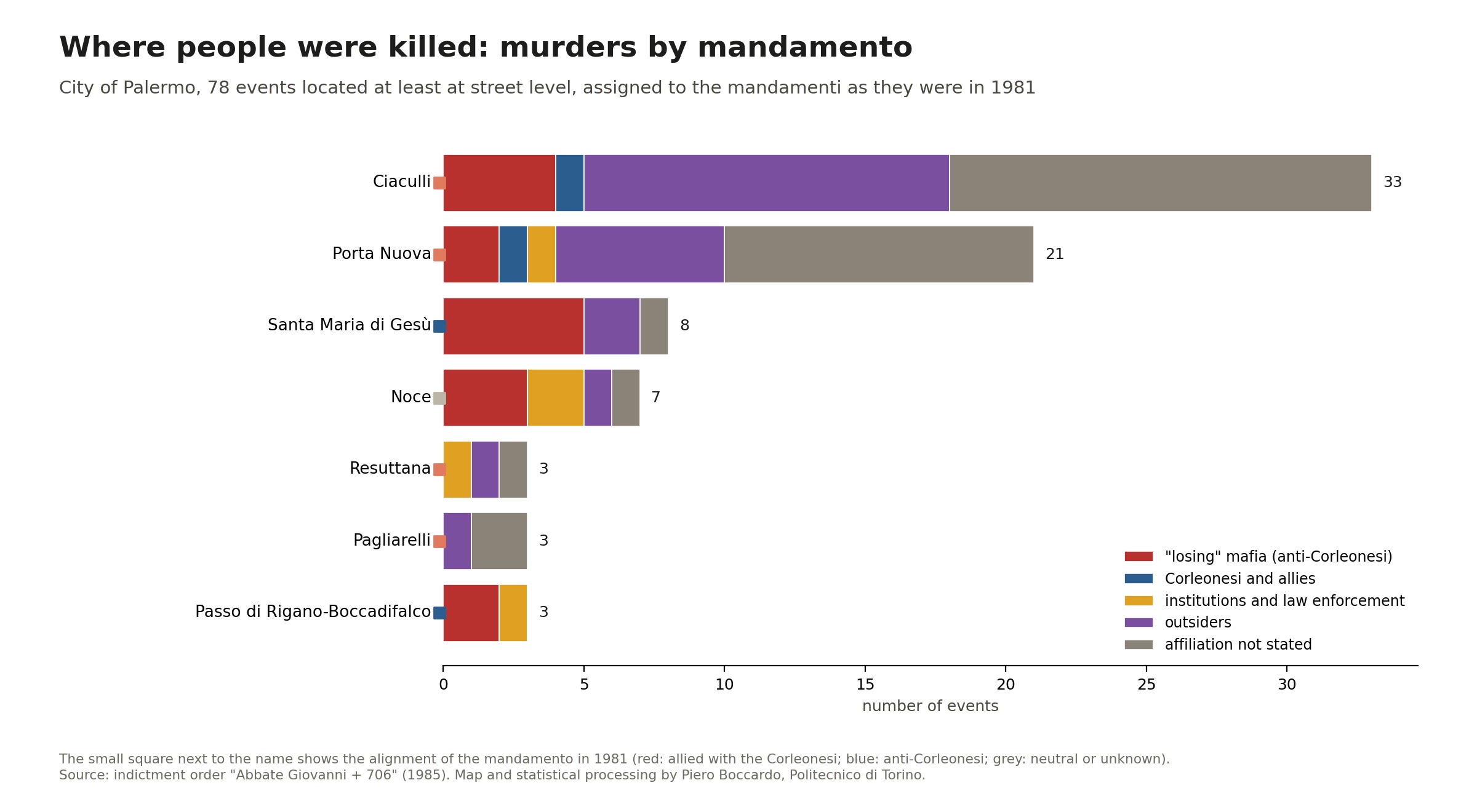 Figure 2. Events located at least at street level assigned to the Palermo mandamenti as they were in 1981, by victims’ affiliation. Source: indictment order “Abbate Giovanni + 706”; author’s processing.
The men of the losing side, by contrast, are largely struck in their own territories. Santa Maria di Gesù, Bontate’s mandamento, has 8 events, 5 of them with anti-Corleonesi victims; Passo di Rigano, Inzerillo’s, has 3, 2 of them with victims of the same faction. This is the strategy described by state witnesses: lure bosses and their men to familiar places, where they suspect nothing, or make them disappear after summoning them to a meeting. Institutional victims, finally, are concentrated in the residential districts north of the historic centre, between via Notarbartolo and via Isidoro Carini. Pontarollo and Ricciuti (2019) had already observed this with a density estimate of mafia murders in Palermo from 1909 to 1992: those who opposed the mafia were mostly killed in the heart of the city, where they lived and worked.
The same pattern emerges, with larger numbers, from the research of Chinnici and Santino (1989) on mafia murders in Palermo between 1978 and 1984: the districts with the most victims were Settecannoli (28), Brancaccio and Ciaculli (26) and Libertà (20). The first two correspond to the eastern strip that dominates our map, the third to the middle-class Palermo of the high-profile murders.
The indictment, after all, investigates only part of the mattanza. Chinnici and Santino (1989) counted 223 mafia murders in the city of Palermo between 1978 and 1984 and 332 including the province, with 1982 as the worst year: 106 dead in the province, 86 in the city. Our 86 city events therefore correspond to just under four murders in ten. What is missing above all are the cases for which the pool had not gathered sufficient evidence and the so-called political murders, such as those of Michele Reina, Piersanti Mattarella and Pio La Torre, which were investigated in separate proceedings.
Beyond Palermo
Widening the view to the island, the 146 Sicilian events investigated in the indictment are added to the vittimemafia.it entries, net of duplicates: 316 murders, attempted murders and disappearances between 1970 and 1992, spread over 72 municipalities (Figure 3). Palermo has 149, Catania 33, followed by Messina and Cinisi with 8, Gela and Carini with 6. Where the text does not give a precise place, the unit of reference is the municipality.
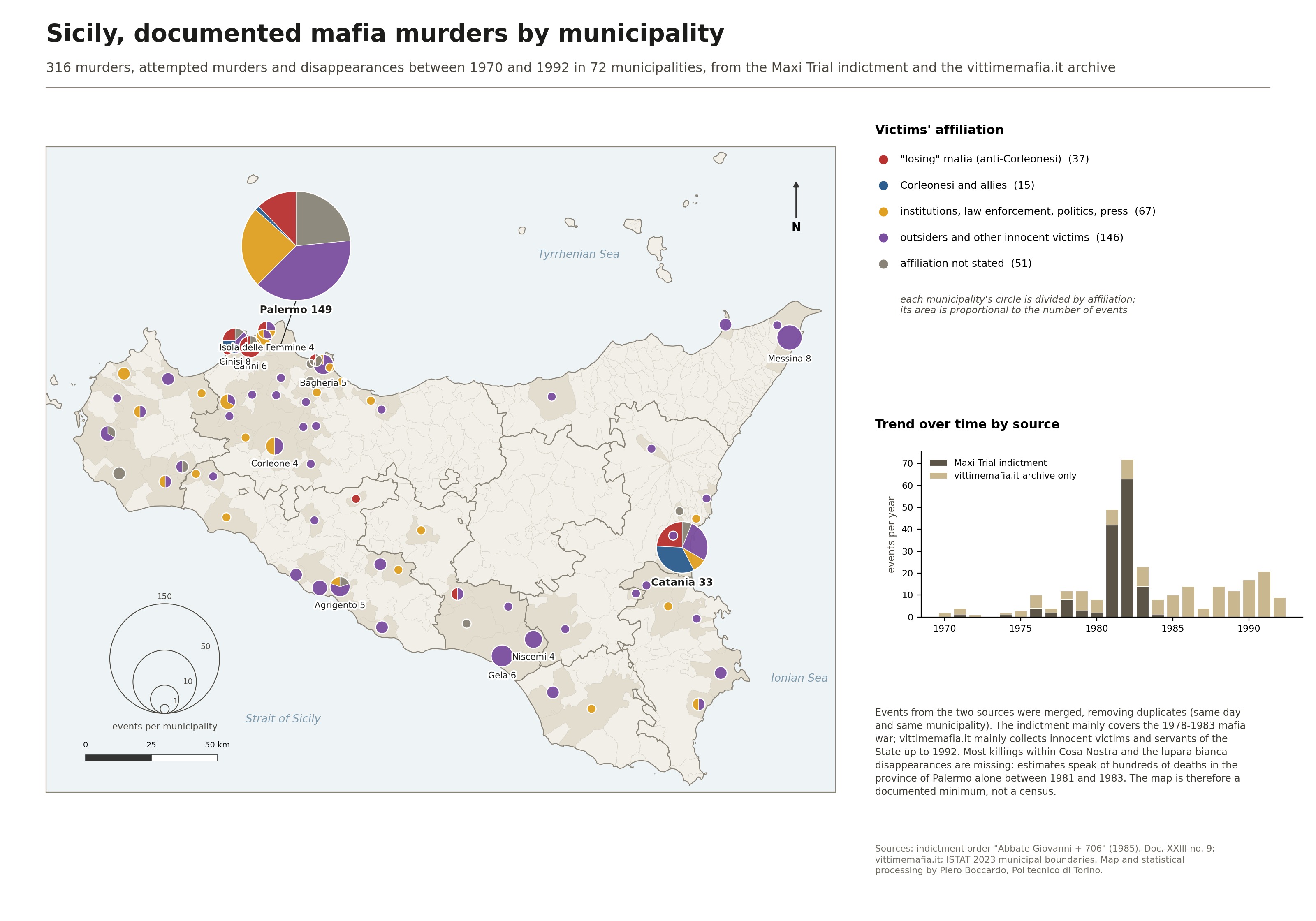 Figure 3. Documented mafia murders, attempted murders and disappearances in Sicily between 1970 and 1992, by municipality. Circle area is proportional to the number of events, the sectors show the victims’ affiliation. On the right, the annual trend by source. Source: indictment order “Abbate Giovanni + 706”, vittimemafia.it archive; ISTAT 2023 municipal boundaries; author’s processing.
Catania, the parallel war
The island’s second city lives through a war of its own, intertwined with Palermo’s. The ambush of 8 September 1978 in Aci Castello against Giuseppe Calderone, representative of the Catania family and promoter of the interprovincial commission, opens the way for Nitto Santapaola, an ally of the Corleonesi. The family splits: on one side Santapaola, on the other Alfio Ferlito, linked to Riina’s opponents. The sixteenth volume of the indictment lists some twenty killings in Catania in 1981 and 1982 as part of this conflict, almost always without stating the exact place. The conflict ends in Palermo on 16 June 1982 with the ring-road massacre, in which Ferlito is killed together with the three Carabinieri of his escort and the driver while being transferred between prisons.
Catania is not just a mirror of Palermo. On 10 November 1979, near a motorway toll booth on the outskirts of the city, three Carabinieri are killed during the transfer of a prisoner, who is kidnapped and later murdered. On 5 January 1984 Giuseppe Fava is killed; he was the founder of the monthly “I Siciliani” and was investigating the relations between Cosa Nostra, politics and Catania’s large construction companies. The province is also home to clans outside Cosa Nostra, which our classification does not distinguish but which contribute significantly to the violence of the 1980s and early 1990s.
Gela, the Agrigento area and the Stidda
From the second half of the 1980s the centre of gravity shifts south. Between Gela, Niscemi, Palma di Montechiaro and Canicattì the Stidda takes hold, an organisation born of men who had left or been expelled from Cosa Nostra and which contests its control of the territory. Figure 4 shows the effect on the distribution of documented events: the provinces of Agrigento, Caltanissetta and Enna rise from 11% in 1984-1989 to 32% in 1990-1992. Gela has 6 events in our dataset, an obvious underestimate: the war between Cosa Nostra and the Stidda claimed dozens of victims there, culminating in the simultaneous ambushes of 27 November 1990 against several amusement arcades in the city, which left eight dead.
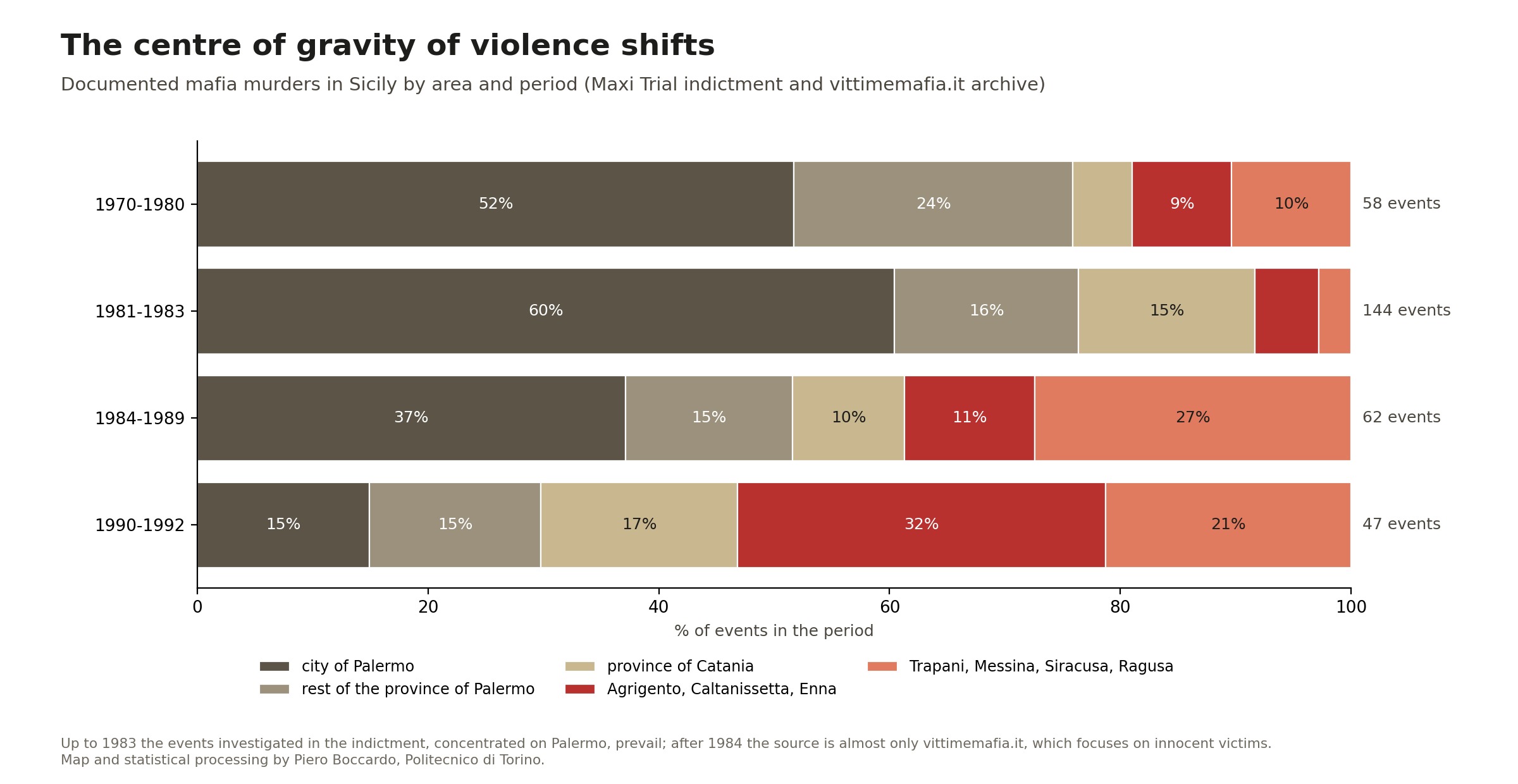 Figure 4. Breakdown by area of documented mafia murders in Sicily, by period. Source: indictment order “Abbate Giovanni + 706”, vittimemafia.it archive; author’s processing.
Two magistrates also fall in this context. On 25 September 1988 judge Antonino Saetta, who was due to preside over the Maxi Trial appeal, and his son Stefano are killed while returning to Palermo. On 21 September 1990, near Agrigento, Stidda killers murder the young magistrate Rosario Livatino. The Racalmuto massacres of 23 July 1991 and 5 November 1992 and the Palma di Montechiaro massacre of 31 December 1991 also strike passers-by and the customers of a bar, victims of a war in which violence no longer spares anyone.
Trapani, the silent province
The province of Trapani, dominated by the Minore family, the Agates of Mazara del Vallo and the Messina Denaros of Castelvetrano, has few events in our dataset, but all of great weight. On 26 January 1983 deputy prosecutor Gian Giacomo Ciaccio Montalto is killed. On 2 April 1985, in Pizzolungo, a car bomb meant for magistrate Carlo Palermo kills Barbara Asta and her twin sons. In September 1988 retired magistrate Alberto Giacomelli, who had ordered the seizure of the house of Riina’s brother, is killed in Trapani, and Mauro Rostagno, who denounced mafia activities on local television, is killed in Valderice. In Figure 4 the provinces of Trapani, Messina, Siracusa and Ragusa together go from 3% of events in 1981-1983 to 27% in 1984-1989.
1991-1992, the final season
According to ISTAT historical series, 1991 marks the peak of homicide mortality in Italy in recent decades, linked among other things to the consolidation of mafia-type organisations (ISTAT, 2026). In Sicily it is the year in which Cosa Nostra awaits the Court of Cassation’s ruling on the Maxi Trial and raises the level of confrontation. On 9 August 1991 in Calabria Antonino Scopelliti is killed, the deputy prosecutor general at the Court of Cassation who was to argue the case for the prosecution in the final judgment; on 29 August in Palermo it is the turn of businessman Libero Grassi, who had publicly refused to pay protection money.
When in January 1992 the Court of Cassation upholds the Maxi Trial, the commission described in the first part, by now entirely in the hands of the Corleonesi and their allies, decides on revenge. On 12 March Salvo Lima, the political referent who had failed to prevent the ruling, is killed in Mondello. On 23 May, on the motorway near Capaci, the explosion kills Giovanni Falcone, Francesca Morvillo and police officers Rocco Di Cillo, Antonio Montinaro and Vito Schifani. On 19 July, in via D’Amelio, Paolo Borsellino dies with officers Agostino Catalano, Walter Cosina, Emanuela Loi, Vincenzo Li Muli and Claudio Traina. On 17 September Ignazio Salvo is killed. This is the end of the season these two parts have told and the beginning of another: on 15 January 1993 Salvatore Riina is arrested in Palermo.
What the data do not tell
The maps in this contribution must be read with a precise awareness: they are a documented minimum, not a census. The two sources that make them up look at violence from different angles. The indictment mainly investigates the mafia war between 1978 and 1983 and focuses on Palermo; vittimemafia.it mainly collects innocent victims and servants of the State, and is almost the only source after 1984. The shift in the centre of gravity in Figure 4 is therefore partly real and partly an effect of the sources. Largely missing are the killings within Cosa Nostra outside Palermo and the victims of the lupara bianca, which by definition escape any count based on the finding of a body: among the events investigated in Palermo alone, 16 of 86 are disappearances, and for the mafia war figures of over a thousand dead have been mentioned, a number that no documentary source can either confirm or refute.
The next step is clear. There is an archive of about 5,000 murders and attempted murders committed in Sicily from 1945 to the present day, built by the University of Palermo with the Public Prosecutor’s Office, with names, dates and places (Zarcone et al., 2025). The police statistics of the Ministry of the Interior cover murders since 1955: a provincial breakdown, not currently available as open data for those years, would make it possible to measure the excess of Sicilian murders over the rest of southern Italy. With these data the maps we have built could be regenerated without any change of method, and the geography of mafia violence in Sicily would move from a documented minimum to a complete picture.
A note on methodology
There are two sources. The first is the Maxi Trial indictment (Parliamentary Antimafia Commission, Doc. XXIII no. 9, 2025): from volumes 13-19, read from the OCR layer of the PDFs, we extracted the events with tome and page references, merging duplicates between dedicated sections and passing mentions when they shared at least one victim and a compatible date. The second is the vittimemafia.it archive, whose entries from 1970 to 1992 we collected through the site’s search interface: 543 across Italy, 183 in Sicily, with the municipality derived from the title and matched against ISTAT names. An event from the two sources was considered the same if it occurred on the same day in the same municipality; 13 duplicates were removed. The victims’ affiliation is the one given in the indictment (“unspecified” does not mean unrelated to Cosa Nostra); for vittimemafia.it entries it was inferred from the title: “institutions” when terms such as Carabiniere, magistrate, journalist, mayor and the like appear, otherwise “outsiders and other innocent victims”.
For the city of Palermo the position of the indictment’s events was derived from the place described in the text using OpenStreetMap geometry, according to four accuracy classes. Class A, within 50 metres: house number present in OSM, house number interpolated between two numbers of the same parity, or junction of the two streets named (10 events). Class B, within 500 metres: square or stretch of street; the point lies on the street and the uncertainty radius is the maximum distance between that point and the street geometry (32 events). Class C, over 500 metres: long street or name occurring more than once in the city, indicative position (36 events). Class D: only the municipality is known (13 events). Street names are those currently in OpenStreetMap, and some streets may have changed name or layout since the 1980s. The assignment to mandamenti in Figure 2 uses the schematic reconstruction of the 1981 urban mandamenti described in the first part and includes classes A, B and C.
At the regional scale the unit of reference is the municipality. In Figure 3 circles are placed at the centre of the municipality, with area proportional to the number of events; the Palermo circle is moved out to sea with a leader line so as not to cover neighbouring municipalities. The areas in Figure 4 are defined on current provinces.
Sources: Parliamentary Commission of Inquiry into the mafia, “Il maxiprocesso di Palermo. Ordinanza sentenza dell’8 novembre 1985”, Doc. XXIII no. 9, 19th legislature, 2025; vittimemafia.it archive; Chinnici G., Santino U., “La violenza programmata. Omicidi e guerre di mafia a Palermo dagli anni ‘60 ad oggi”, Franco Angeli, 1989; Pontarollo N., Ricciuti R., “Mafia murders in Palermo (1909-1992)”, Journal of Regional Security, 2019; ISTAT, “Dei delitti e delle pene: criminalità, giustizia, detenzione”, Storie di dati, 2026; Zarcone D., Glaviano G., Tumminello M., Miccichè S., “Mafia Murders as a Complex System: Temporal Patterns and Statistical Modeling”, poster, 2025; base map © OpenStreetMap contributors (ODbL); ISTAT 2023 municipal boundaries; map and statistical processing by Piero Boccardo, Politecnico di Torino.