The Corleonesi and the geography of Cosa Nostra from 1974 to 1992
How a faction born in a small town in the Palermo hinterland took control of the whole organisation, one mandamento at a time. Part one of two
by Piero Boccardo
In May 2025 the Italian Parliamentary Antimafia Commission published in full the indictment order of 8 November 1985 with which Giovanni Falcone, Paolo Borsellino and the other judges of the antimafia pool sent 476 defendants to trial, paving the way for the Palermo Maxi Trial. It runs to 8,608 pages in 43 volumes, divided into ten tomes. We read the parts describing the structure of Cosa Nostra, the mafia war and the murders, extracted families, bosses, dates and places in structured form, and cross-checked them against the reports of the Antimafia Investigative Directorate (DIA), the Antimafia Commission and the available literature. The result is a territorial reconstruction of Cosa Nostra at five moments, from 1974 to 1992. One figure sums it all up: in 1974 the Corleonesi and their allies controlled mandamenti covering about 21% of Sicily’s land area; by 1992, the year of the Capaci and via D’Amelio bombings, they had reached 61%, practically all the territory where a Cosa Nostra presence is documented.
This is the first of two contributions. Here we tell the story of the conquest of territory and of internal power. The second will be devoted to the geography of violence: murders in Palermo during the years of the “mattanza” and then across Sicily, from Catania to the war with the Stidda, up to the 1992 bombings.
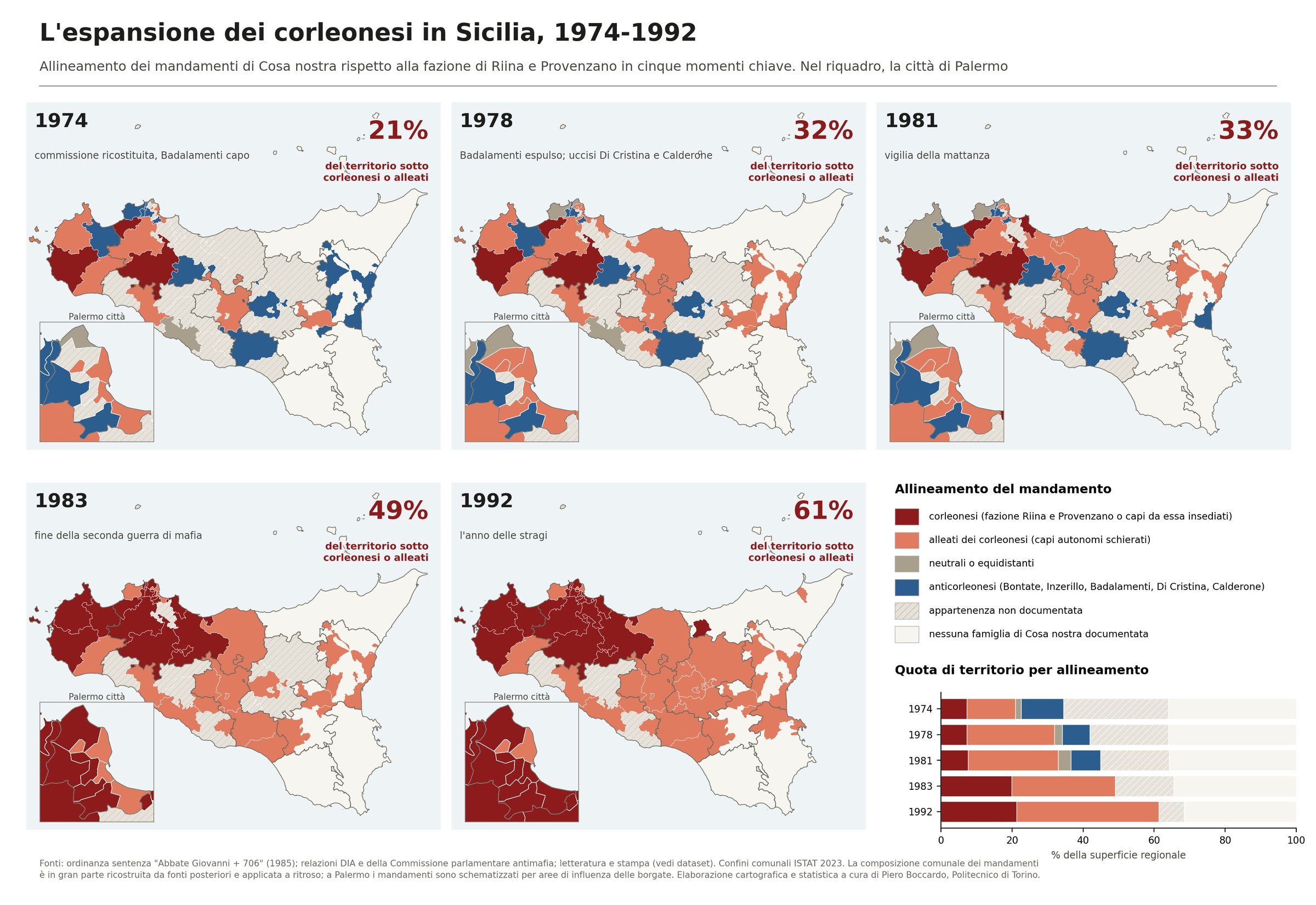 Figure 1. Alignment of Cosa Nostra mandamenti with the Riina and Provenzano faction at five key moments, with a detail of the city of Palermo and the share of regional territory by alignment. Source: indictment order “Abbate Giovanni + 706”, DIA and Antimafia Commission reports, literature; author’s processing.
Families, mandamenti, commission
Reading the maps requires a short introduction to the organisation, as Tommaso Buscetta described it to Falcone and as the fifth volume of the indictment reconstructs it. The basic unit is the family, rooted in a neighbourhood of the city or in a municipality and led by a boss elected by the men of honour. Three or more contiguous families form a mandamento, whose head sits on the provincial commission, the “cupola”. In the city of Palermo there were eight or nine mandamenti, identified with its districts: Porta Nuova, Santa Maria di Gesù, Ciaculli, Passo di Rigano, Noce, Pagliarelli, Resuttana, San Lorenzo, Partanna Mondello. In the province the mandamenti coincided with groups of municipalities around a centre: Corleone, San Giuseppe Jato, Partinico, Cinisi, Bagheria, Caccamo, the Madonie. Outside the province of Palermo the structure was less articulated, and the sources often document only the families and their provincial representatives.
The Palermo commission, dissolved after the Ciaculli massacre of 1963, was re-established in 1970 as a triumvirate: Gaetano Badalamenti, head of the Cinisi family, Stefano Bontate of Santa Maria di Gesù, and Luciano Leggio, head of the Corleonesi, replaced in practice by Salvatore Riina because he was a fugitive. In 1974, after Leggio’s arrest, the commission returned to its full composition with Badalamenti at its head. At that moment Corleone was one mandamento among others, powerful in the inland countryside but outside the economic heart of the organisation, which lay in Palermo and in the heroin trade run by the Bontate, Inzerillo and Badalamenti families.
1978, the turning point
The first map in Figure 1 shows a Cosa Nostra that is still plural. In 1974 the areas aligned with the Corleonesi or allied with them are a minority: Corleone, Partinico, San Giuseppe Jato, Michele Greco’s Ciaculli, Pippo Calò’s Porta Nuova, Mariano Agate’s Mazara del Vallo, the Madonias’ Vallelunga. Of comparable weight are the areas linked to Bontate, Inzerillo and Badalamenti in Palermo, to Giuseppe Di Cristina in Riesi and to Giuseppe Calderone in Catania, both members of the interprovincial commission set up in 1975 at Calderone’s own initiative. A third of the territory with a documented mafia presence has an uncertain alignment, and this must be kept in mind: in those years the judicial sources mostly tell the story of Palermo.
1978 is the first breaking point. Badalamenti is expelled from the commission and replaced by Michele Greco, known as “the Pope”, who gives the Corleonesi a friendly chairmanship. In the same year the two bosses who most openly opposed Riina outside Palermo are eliminated. Giuseppe Di Cristina, who had spoken to the Carabinieri about the Corleonesi’s intentions, is killed on 30 May 1978 in via Leonardo da Vinci in Palermo, in the territory of the Inzerillo family. Giuseppe Calderone is shot in Aci Castello on 8 September and dies a few weeks later; in Catania his place is taken by Nitto Santapaola, an ally of the Corleonesi. The maps record the shift: the share of territory under the Corleonesi or their allies rises from 21 to 32%, mainly because of the alignment of the Catania family and of the inland areas of the province of Caltanissetta, where after the killing of Francesco Madonia his son Giuseppe, known as Piddu, a supporter of Riina, takes over.
The mattanza and the redesign of 1983
Between 1978 and the spring of 1981 the geography changes little: the share goes from 32 to 33%. What makes the difference is the balance inside the commission, which maps cannot show. Riina and Provenzano build a network of loyal men inside families formally led by others, circumventing the rule of membership of a single family, and use the commission’s power to suspend bosses and appoint regents. When the war begins, many of the “losing” families have already been hollowed out from within.
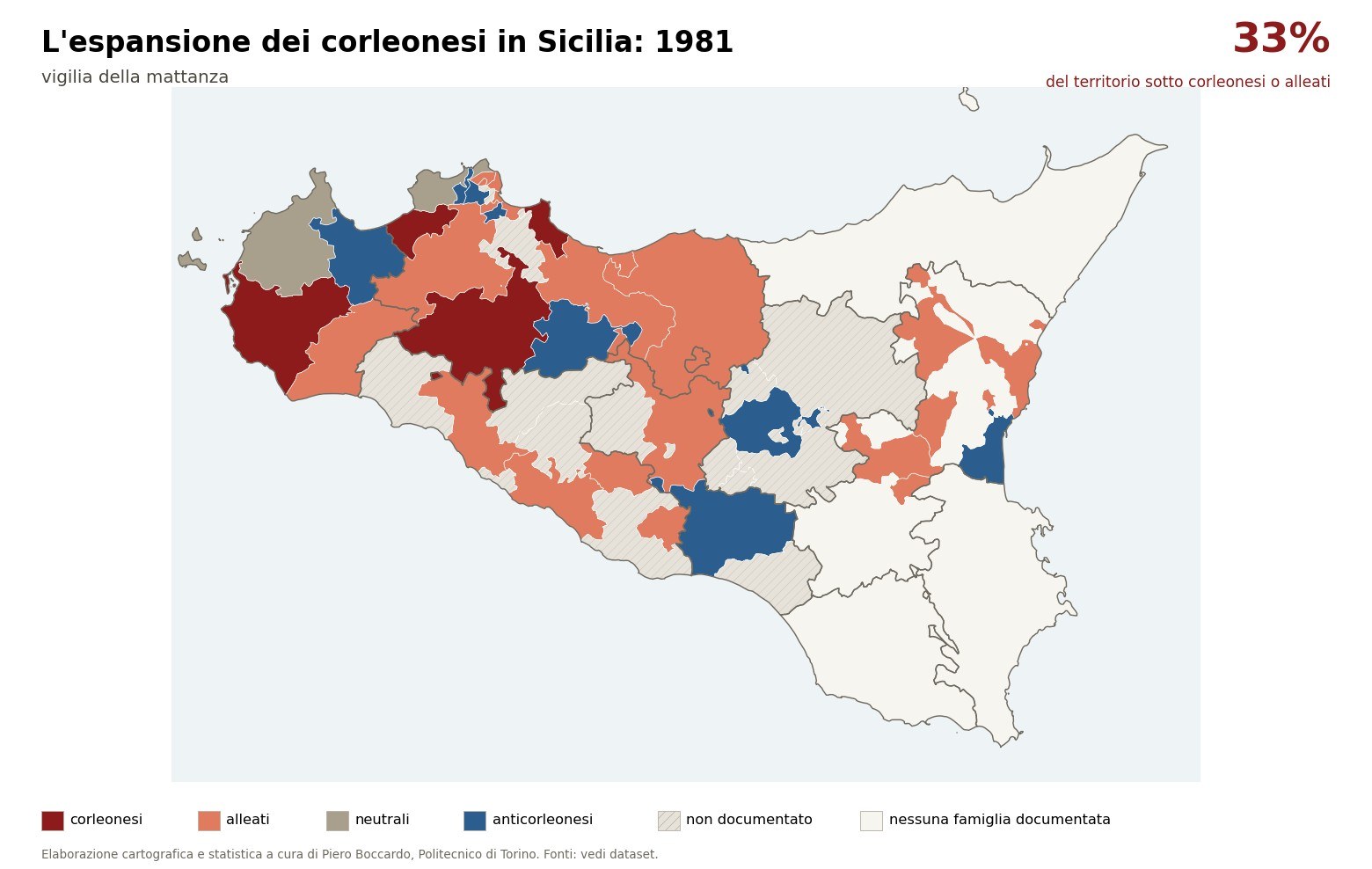
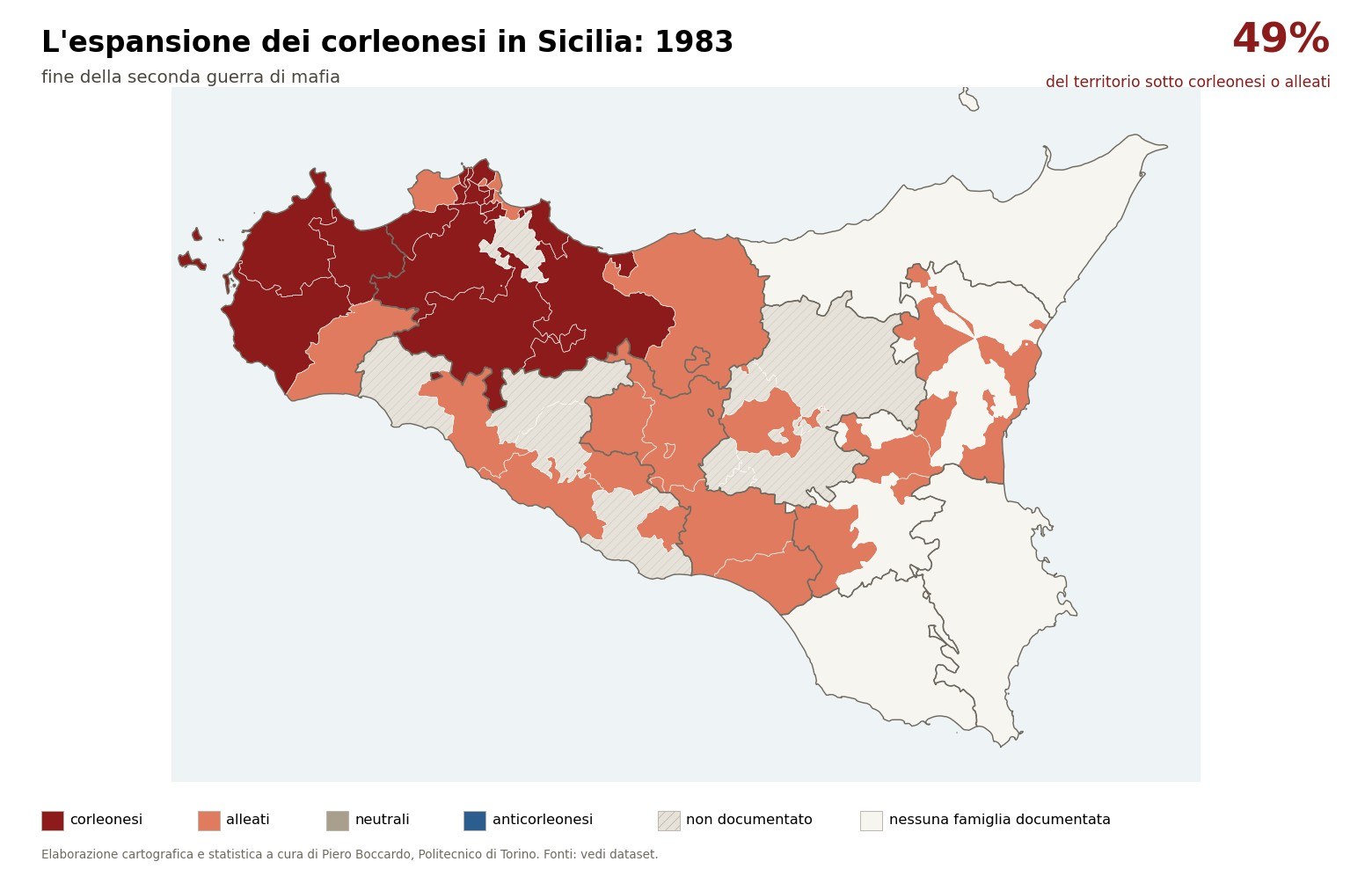
Figure 2. Cosa Nostra’s Sicily on the eve of the second mafia war (1981) and at its end (1983). Source: author’s processing of the indictment order, DIA reports and literature.
On 23 April 1981 Stefano Bontate is killed in Palermo at the junction of via Aloi and viale della Regione Siciliana. On 11 May it is the turn of Salvatore Inzerillo, shot in via Brunelleschi with the same assault rifle. On 26 May Girolamo Teresi, Giuseppe Di Franco and the brothers Angelo and Salvatore Federico, Bontate’s men, disappear after being summoned to a farmstead in Villagrazia: this is the “lupara bianca”, murder without a body, which accompanies the whole war and makes a complete count of the victims impossible. On 29 September 1981 Calogero Pizzuto, head of the Castronovo di Sicilia and Vicari mandamento and the only boss of the province openly aligned with Bontate, is killed together with two other men; his territory passes to Francesco Intile of Caccamo, by a decision communicated by Michele Greco.
The second wave hits those who had remained in the middle. On 16 June 1982 Alfio Ferlito of Catania, Santapaola’s rival, is killed on Palermo’s ring road while being transferred between prisons, together with the three Carabinieri of his escort and the driver. On 30 November 1982 Rosario Riccobono, head of Partanna Mondello, who had kept a balance between the two factions, and Salvatore Scaglione, head of the Noce, are both eliminated on the same day. A few days earlier, according to the statements of state witnesses, Totò Minore, head of the Trapani family, whom Riina considered unreliable because of his neutrality, had been strangled in Palermo.
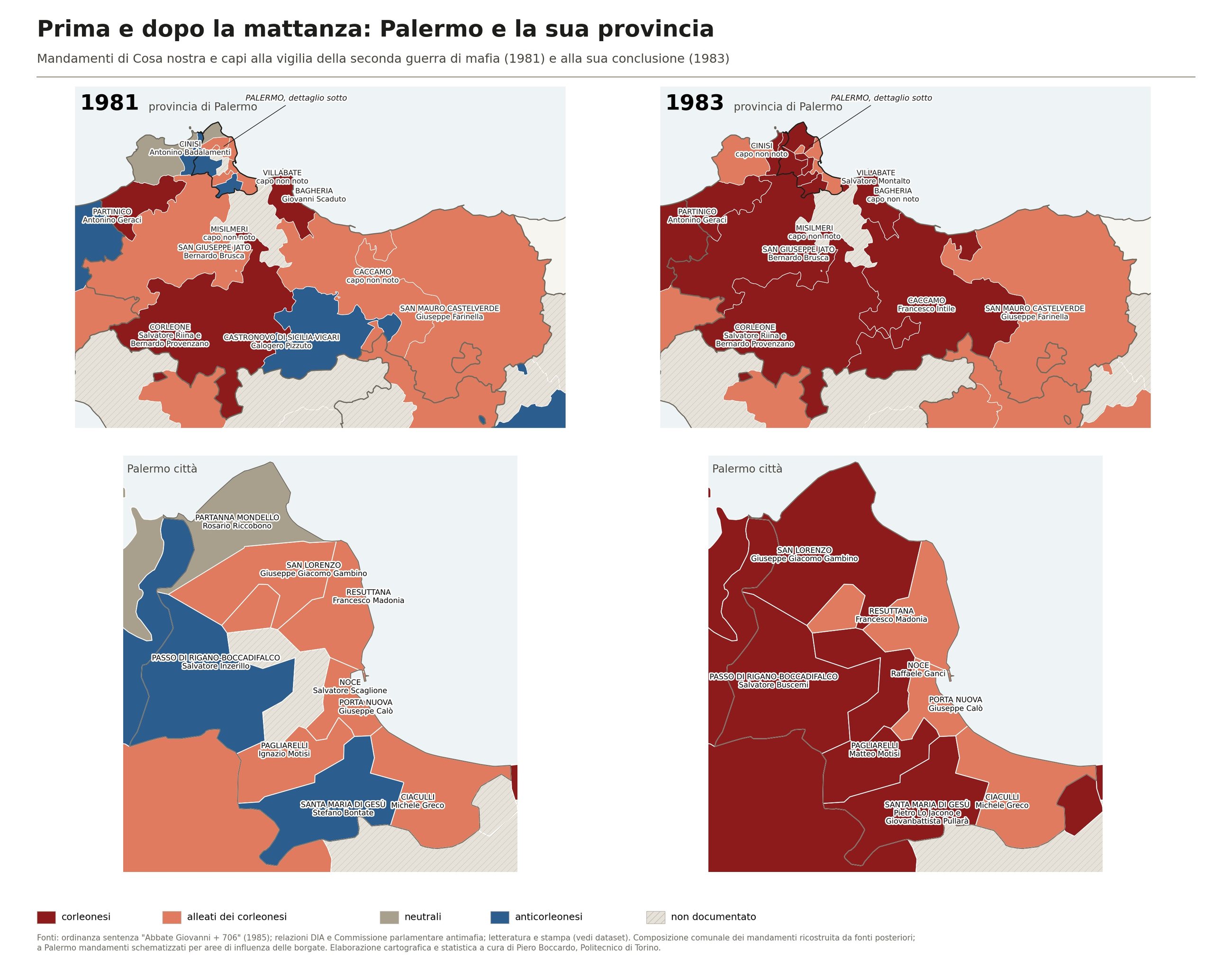 Figure 3. Palermo and its province before and after the mattanza: mandamenti, bosses and alignment in 1981 and 1983. The city mandamenti are drawn schematically as areas of influence of the districts. Source: indictment order “Abbate Giovanni + 706”, Antimafia Commission, literature; author’s processing.
Figure 3 shows the effect at the provincial scale. In 1981 the blue of the anti-Corleonesi mandamenti covers Santa Maria di Gesù, Passo di Rigano and the Castronovo area; by 1983 the blue has disappeared. In place of the murdered bosses the commission installs trusted regents: Pietro Lo Jacono and Giovan Battista Pullarà in Santa Maria di Gesù, Salvatore Buscemi in Passo di Rigano, Raffaele Ganci in the Noce, Giuseppe Giacomo Gambino in San Lorenzo, which absorbs Partanna Mondello, Matteo Motisi in Pagliarelli, Salvatore Montalto in Villabate, Vincenzo Virga in Trapani. In just two years the share of regional territory under the Corleonesi or their allies rises from 33 to 49%, and the part governed directly by bosses of the faction or installed by it goes from 8 to 20%.
1992, a single command
The years of the Maxi Trial do not stop the expansion; they consolidate it. Pino Greco, the most feared killer of the war, is murdered in 1985 on Riina’s orders; Michele Greco is arrested on 19 February 1986 and the chairmanship of the commission passes de facto to Riina. In Brancaccio and Ciaculli the Graviano brothers rise, in Porta Nuova Salvatore Cancemi replaces the imprisoned Calò, in San Giuseppe Jato Giovanni Brusca takes over from his father Bernardo. Outside Palermo the same logic produces a system of alliances: Santapaola in Catania, Piddu Madonia in Caltanissetta, Mariano Agate in Mazara del Vallo, Francesco Messina Denaro in Castelvetrano. Whoever strays from the line is eliminated, like Vincenzo Milazzo, head of Alcamo, killed on 14 July 1992.
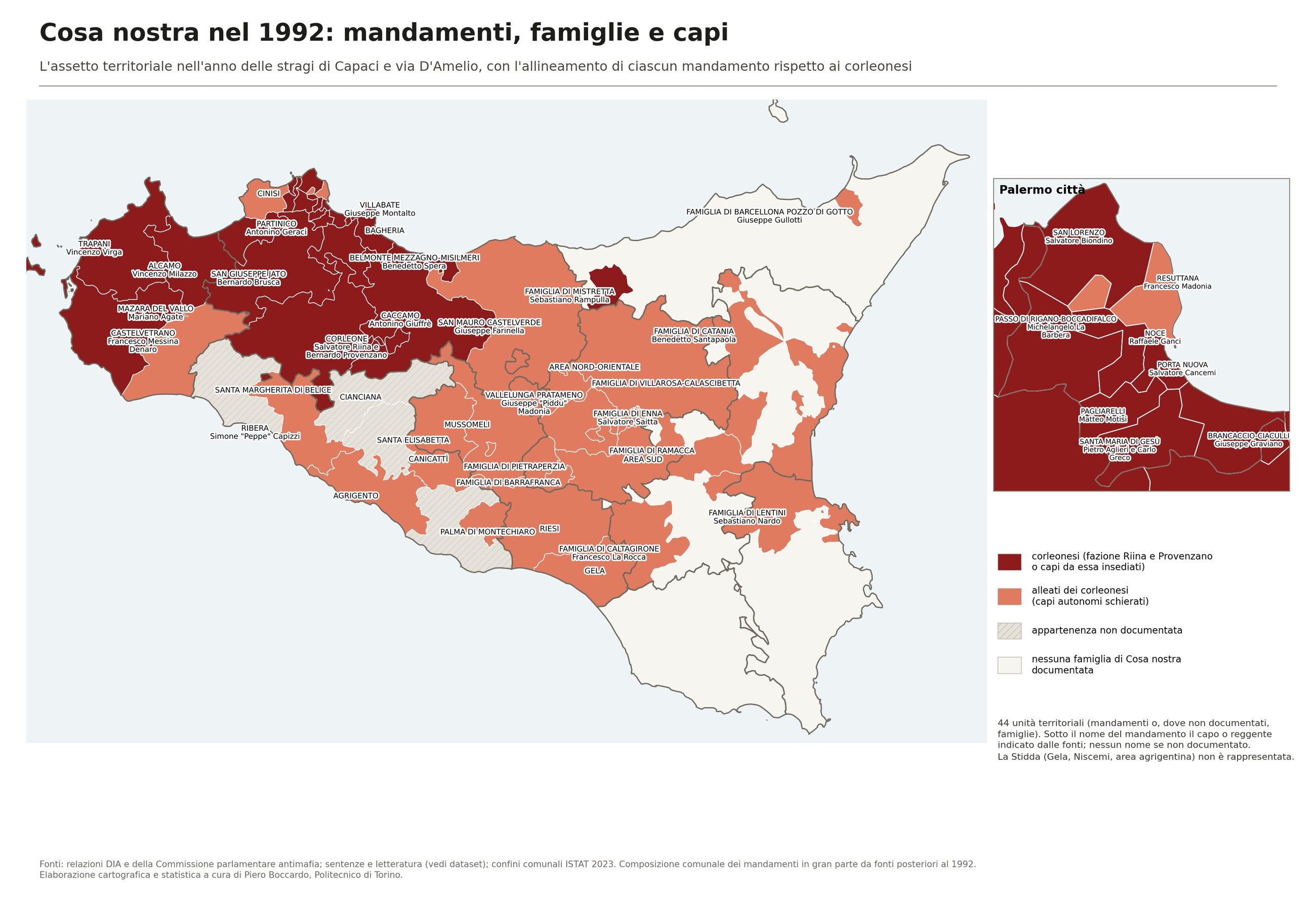 Figure 4. Cosa Nostra in 1992: mandamenti or, where these are not documented, families, with the boss or regent indicated by the sources and the alignment with the Corleonesi. Source: DIA and Antimafia Commission reports, court rulings and literature; ISTAT 2023 municipal boundaries; author’s processing.
In 1992 not a single documented mandamento in Sicily remains aligned against Riina. 61% of the island’s land area is in the hands of the Corleonesi or their allies, 7% has an alignment that the sources do not allow us to establish, and the rest is the eastern and southern Sicily where a Cosa Nostra presence is not documented or where other organisations operate, such as the Stidda or the Catania clans outside Cosa Nostra. It is this commission, by now reduced to the instrument of a single faction, that decides the season of the bombings: Salvo Lima in March, Falcone in May, Borsellino in July. The geography of the maps explains why there was no one inside the organisation able to oppose it.
A note on methodology
The core of the data comes from the Maxi Trial indictment order in the edition published by the Parliamentary Antimafia Commission (Doc. XXIII no. 9, 2025). The text was read from the OCR layer of the PDFs and structured into records with tome and page references. For the years after 1985 and for provinces other than Palermo we added DIA reports, Antimafia Commission documents, court rulings cited in the literature and, as a guide to primary sources, encyclopaedia entries. Each attribution in the dataset has a source and a reliability grade, and more than half of the attributions outside Palermo before 1983 have low reliability.
Two choices must be declared. The first concerns boundaries: no source of the period describes the mandamenti as areas. Their municipal composition almost always comes from the most recent DIA reports (2015-2022) and has been applied backwards; the polygons are obtained by merging the 2023 ISTAT municipal boundaries. For the city of Palermo the mandamenti have been drawn schematically as areas of influence (Voronoi polygons) around the districts attributed to each, clipped to the municipal boundary. The second concerns alignment: we distinguish bosses belonging to the Riina and Provenzano faction or installed by it (“Corleonesi”) from autonomous bosses who sided with them (“allies”). Percentages are computed on land area, not population, and should be read as an order of magnitude of the expansion, not as a precise measure of control.
Sources: Parliamentary Commission of Inquiry into the mafia, “Il maxiprocesso di Palermo. Ordinanza sentenza dell’8 novembre 1985”, Doc. XXIII no. 9, 19th legislature, 2025; Antimafia Investigative Directorate (DIA), half-yearly reports to Parliament (2015-2022); Parliamentary Antimafia Commission, reports and documents of the 10th-17th legislatures; ISTAT 2023 administrative boundaries; map and statistical processing by Piero Boccardo, Politecnico di Torino. Published on Linkiesta, October 24, 2026.